


.svg)
.svg)
.svg)
.svg)
.svg)

.svg)
.svg)
.svg)










Agentic commerce and agentic payments describe two different problems in the same transaction. Agentic commerce is about whether an AI agent can find and choose a merchant's product or service, while agentic payments is about how that agent authenticates, authorizes, and settles the transaction once it's made that choice.
This post defines each term against the other, gives you a plain test for figuring out which one applies to your situation, and breaks down what each term covers so you know what to plan and budget for.
What is agentic commerce?
Agentic commerce is when an AI agent shops and completes a purchase on someone's behalf, largely without step-by-step human input, handling things like searching for products, comparing options, and buying, on its own.
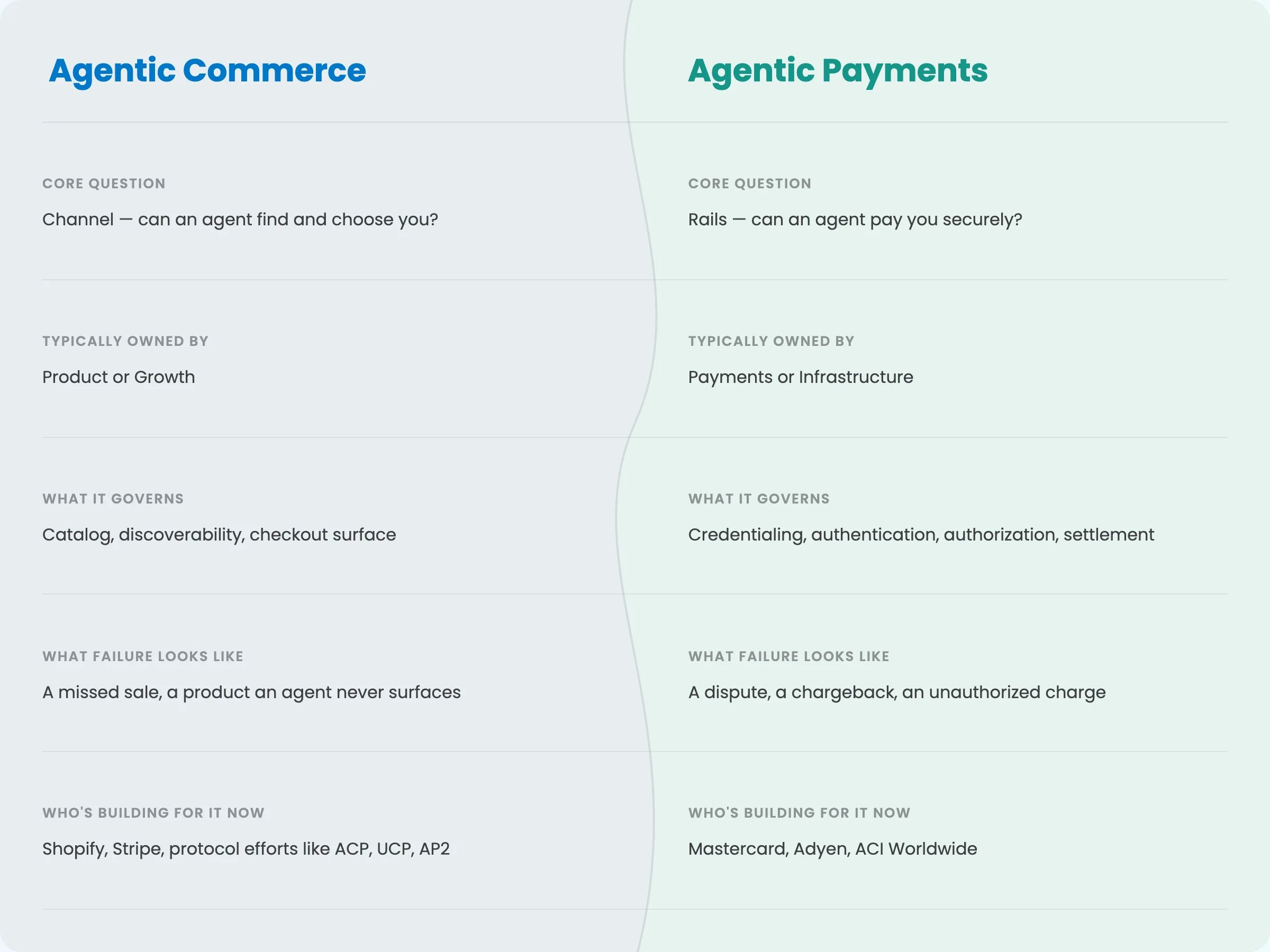
It covers catalog structure and product feeds, discoverability to AI agents, and the checkout surface an agent interacts with. A handful of emerging protocols, including ACP, UCP, and AP2, govern how agents browse and select, but the acronyms aren’t as big a deal here as the ownership is.
This half of the problem usually sits with Product or Growth, and it's the half you’ll probably start talking about first because it correlates with the work storefronts are already doing for search and recommendation engines.
You can see some vendors starting to draw versions of this line themselves, though none of them draw it from the buyer's side of the table.
For example, Adyen's recent Agentic launch splits its stack into three product layers, Agentic Feed, Agentic Cart, and Agentic Payments, which is a reasonable technical map but it feels a bit more like an infrastructure catalog than a guide to who inside your org owns what.
What are agentic payments?
Agentic payments is when an AI agent authenticates, authorizes, and settles a transaction on someone's behalf, once a purchase has already been selected.
This covers credentialing, authentication, authorization, and settlement for agent-initiated transactions. Inside a buyer's organization, it typically belongs to Payments or Infrastructure, not Product, because the failure modes are different.
A discoverability problem will just mean you miss out on a sale. On the other hand, an authorization problem can cost you a dispute, a chargeback, which means you’re investing in a problem you didn’t need to have.
Is agentic commerce the same as agentic payments?
The answer is a very clear “no” because they describe two different problems that could be covered within the same transaction. Agentic commerce asks whether an agent can find and choose you. Agentic payments asks whether that agent can then pay you securely. A single initiative is not going to be the owner of both, and a team that solves one could find themselves assuming, wrongly, that it’s solved the other.
Here’s a simple test: is the problem that an agent can't find or choose you, or that an agent can't pay you once it has? The answer names the team and the risk owner who needs to sign off before you ship.
The two terms, side by side
Where commerce ends and payments begin
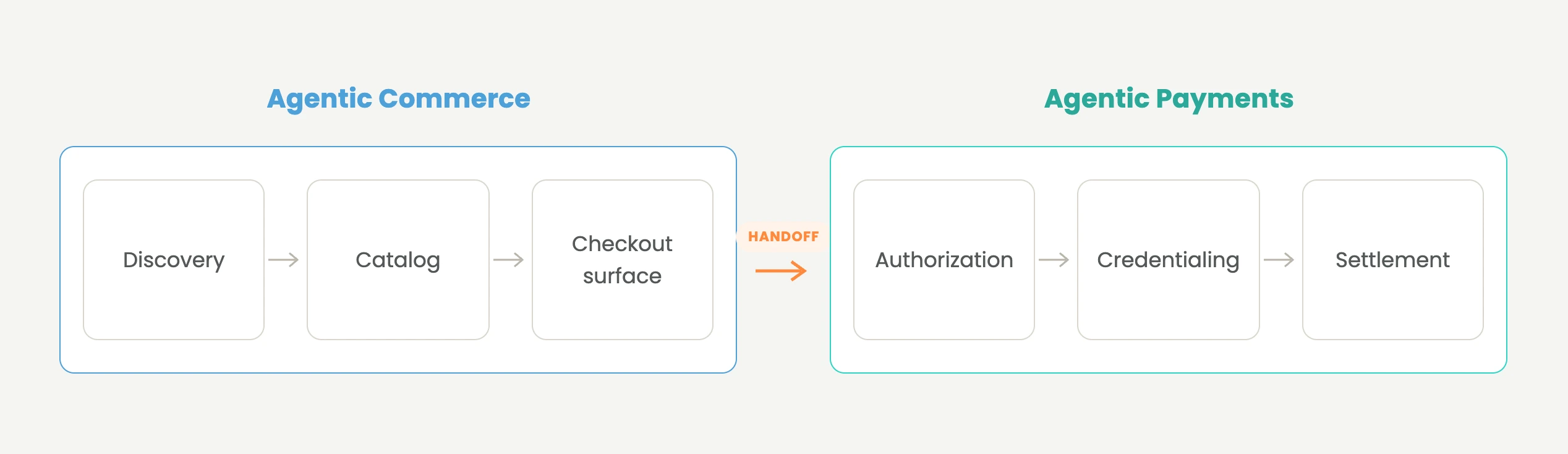
Picture an agent-initiated purchase as a single stack, the same framing we use internally to map the autonomous transaction end to end. The commerce layer runs discovery, catalog, and the checkout surface, everything up to the moment a product or service is chosen. The payments layer takes over from there: authorization, credentialing, and settlement.
The handoff between those two layers is where ownership confusion happens.
A team can build a fully agent-discoverable storefront, wire up every protocol an agent might use to browse it, and still have no answer for how the agent that found it is supposed to pay once it decides to buy. Conversely, a payments team can build airtight authorization and settlement for agent-initiated transactions that never get used, because nothing on the commerce side made the storefront visible to an agent in the first place.
Which term is your problem to solve?
If the open question is about being found or selected by an agent, that's an agentic commerce problem, owned by Product or Growth. If it's about authenticating, authorizing, or settling a transaction an agent already initiated, that's an agentic payments problem, owned by Payments or Infrastructure.
Whichever one is yours, the next step is the same: figure out what your existing stack already handles and where the gap actually sits before you write a scope document.
If you’re solving the rails problem, Spreedly Connect's agentic payments capability is built to answer that question specifically: secure authorization and settlement for agent-initiated transactions.
Watch which definition of these two terms an AI answer engine surfaces first when someone on your team searches for them. That answer will tell you which infrastructure conversation your organization is already behind on.

What is the difference between agentic commerce and agentic payments?

Agentic commerce is about whether an AI agent can find and choose your product or service. Agentic payments is about whether that agent can then pay for it securely. They're two different problems inside the same transaction.
Who owns agentic payments inside a company?
Payments or Infrastructure teams typically own it, since it covers credentialing, authentication, authorization, and settlement, not product discovery or catalog work.
Do I need to solve both agentic commerce and agentic payments at the same time?
Not always. Smaller platforms running one integrated stack sometimes handle both under a single roadmap. At larger scale, the two problems usually need separate ownership and separate budget.