


.svg)
.svg)
.svg)
.svg)
.svg)

.svg)
.svg)
.svg)










Companies in the middle of designing their payment orchestration aren’t halfway to success, they’re picking up marginal gains and leaving the majority of the upside untouched.
Those who implement three or four payment orchestration capabilities are only 43% more likely than beginners to see a 2%+ transaction completion gain. On the other hand, companies with all five core orchestration capabilities are 1,014% more likely than beginners to see those gains.
The rewards of implementing orchestration are strictly non-linear. Starting is good, but the value is in seeing it through.
Understanding the capability tiers
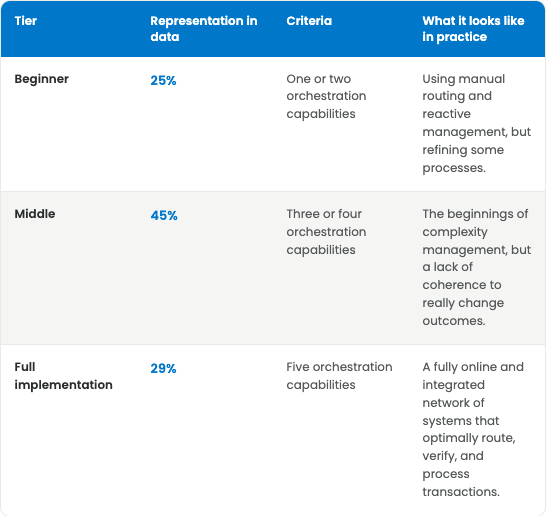
Throughout this article, we’re going to group companies into three groups based on their progress with implementing payment orchestration.
What the tiers actually represent
The data in our report The Orchestration Advantage: How Routing Architecture Shapes Payments Performance looked exclusively at companies who are working on implementing payment orchestration. There are, of course, many companies that aren’t engaging in this process, but they are not included in the data.
The five capabilities that define full deployment
Payment orchestration is inherently complex and a successful deployment can look very different between two businesses. The five core components that appear most universally are:
- Automated dynamic routing
- Routing logic update frequency
- Failover and redundancy implementation
- Token control
- New payment rail ease
Our research went beyond checking whether these components existed, but whether they were fully operational and interoperable. Having the capabilities in place is one thing, but having them working in unison and dynamically is the real measure of success.
What the data actually shows about the middle tier
Any company that is working on implementing payment orchestration deserves credit. They clearly care about ownership, optimization, and customer experience. The challenge to overcome is that a half-completed deployment is barely better than the basics. These companies need to go all-in if they want to enjoy the real benefits of orchestration.
Completion gains: 10% vs 7% vs 78%
Transaction completion gains are the gold standard for any payments project. When changes to your payments stack can visibly impact the company’s P&L, you know you’re doing something worthwhile.

The gap between a company starting out and one halfway through the process is just three percentage points. Those final one or two components that take a company to full implementation lead to a 68 percentage point increase.
If you’re partway through deploying your orchestration stack, the worst thing you can do is stop now. The investment you’ve made so far will only show up in your performance if you see it through to completion. Otherwise, you’ll end up with an expensive and complex system that is statistically indistinguishable from where you were months earlier in the process.
PYMNTS call this the “capability trap” – whereby incremental upgrades introduce operational complexity faster than they improve performance. The tipping point arrives when the systems aren’t just online, but integrated with each other.
Same-day resolution: where the middle tier falls below the bottom
If the completion gain data is interesting, the same-day resolution data is astonishing. The middle tier (6%) isn’t just behind the top tier (47%), it’s significantly behind the bottom tier (18%).
It’s counterintuitive, confounding, and has all the appearances of noise rather than signal. Until you come back to PYMNTS’ capability trap. The companies in the middle tier are adding layers of complexity and tools that could help, but only if they interact coherently. Partial implementation adds dependencies without the infrastructure to accompany them.
This is why The Orchestration Advantage concludes that “orchestration is an all-or-nothing process. Companies that succeed are those that deploy all five capabilities at once.”
Abandonment and complaints: the customer-facing cost
Completions, resolutions, and routing are great operational metrics for you to measure your progress with orchestration. They’re also largely irrelevant to the end-user: your customer.
Cart abandonment and complaints are popular customer-facing metrics for good reason. They capture behavior and tie directly to impacts on your brand and revenue. The same story we saw with same-day resolution appears in these metrics, too. The middle suffers most.
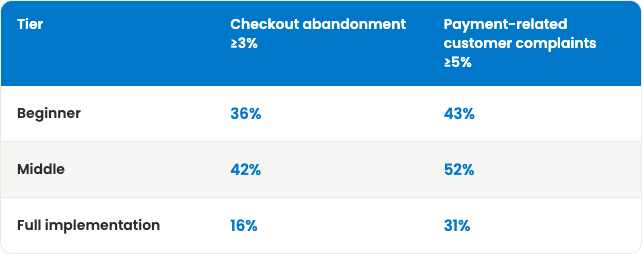
It’s a cruel irony that the teams who are trying to improve standards and quality of service can, at least initially, exacerbate or create new issues. The key takeaway isn’t that they should abandon their orchestration project, rather, they need to double down on seeing it through. Out the other side of the struggle is a meaningful shift in customer satisfaction.
Why partial deployment produces these results
The statistics tell us what (that partial deployment creates an inverse effect), but the value lies in understanding the why. Even better is to understand the solution.
Complexity without coherence
The first - and possibly most important - idea to grasp is that these five capabilities are not designed to be standalone features of a payment stack. They are necessary components, but they only work optimally as a unified system. Think of pancakes – flour, milk and eggs don’t make much of a meal on their own, but, when mixed together, they produce something brilliant.
Take automated routing, for example. Without token control operating in-sync with it, your payments system can reroute transactions but cannot do so without triggering credential dependencies.
Likewise, implementing failover without real-time monitoring means your primary system can go offline and stay there until you run a manual check and switch.
For every incomplete capability you set live in your back-end, you add a dependency that your system can’t fully sustain under pressure. The return appears only when all five capabilities function together as a system.
The engineering overhead of an incomplete stack
Amid the costs to conversion, retention, and overall payment orchestration performance, there’s another consideration for your business: the demand on your engineering resources.
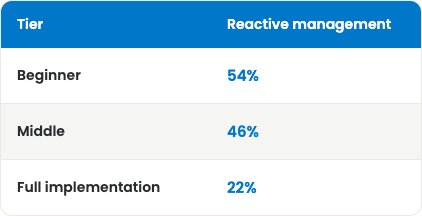
A half-implemented payment stack is an engineering drain in all the worst ways. It adds providers, integrations, and surfaces to monitor and manage. These are all potential points of failure and all pulling engineering time away from strategic work and into vendor management.
When you complete a full migration to an orchestrator, this goes away. The frantic dance from vendor to tech to vendor (and so on) largely stops on day one. An orchestrator is the centralized layer that removes all the bloat from a troublesome payment stack and gives engineers the time, space, and freedom to do their most meaningful work.
A final data point from the report highlights this perfectly. Again, the greatest gains are found in finishing the implementation, not being halfway there.
What to do if you are in the middle
The story in the data can't be ignored. Teams that are looking for true payment orchestration ROI must prioritize seeing the task through. If they don’t, they put checkout and team performance at risk.
If you’re stuck in that messy middle area right now, there is a path out - and the rewards will be handsome.
Stop adding, start completing
Your instinct might be to try a new provider or build, adding to and iterating on what you already have. You are looking at a fire and preparing to put it out with a stick. Do not make this mistake.
The solution isn't more features, it’s a step back. You need a rigorous and honest audit of your five orchestration capabilities. Your aim now is to complete - and integrate - the full stack of capabilities.
We found that 88% of companies plan further orchestration enhancements before 2028. The budget is there and so is the will. Where companies choose to direct it will be the point of divergence. You could spend all of that capital and find yourself deeper in the trap. Or you could spend it on completing the work you’ve started. Then you’ll finally unlock those returns.
The five-capability audit
That hopefully sounds good, but knowing where to start isn’t always obvious There is one key question that should drive your audit: “Is this capability fully operational, working automatically, and in communication with the other four?”
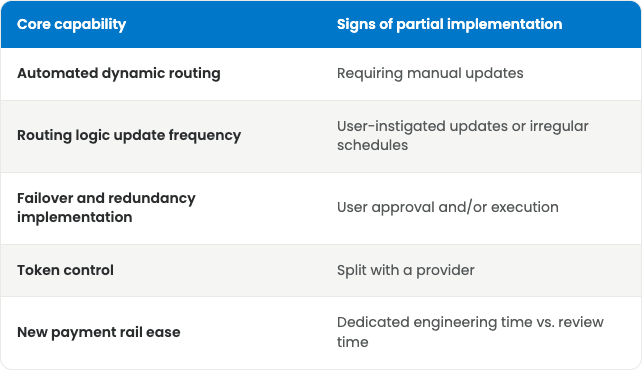
After an honest audit, you’ll have clear areas of focus. Get that work live and you’ll be in the 71st percentile for payments performance straight away. The gains are there to be enjoyed across performance, customer, and internal output metrics.
The case for completing the stack before expanding it
It might sound daunting or disheartening - you put in a lot of work to add tools and capabilities to your payment stack, only to hear that it’s created a new issue down the line. The positive angle is that you have a clear opportunity in front of you. The work you do from here will deliver demonstrably better performance and outcomes.
Two-thirds of full implementation companies have approval rates above 97%. Almost half enjoy same-day resolution and authorisation rates of 94.5% (a 9.5-point increase from baseline). This is not a project that gets lost on a Jira board, this is revenue-driving, brand-boosting, quality-enhancing work that will make waves in your company.
And it’s wonderfully simple. To reach this promised land, you don’t have to build something new or invest in another platform. You have to get into the projects you’ve already ticked off and tweak, refine, and close out the work.
See it through and you’ll see tangible results, fast.

Why do companies in the middle of payment orchestration implementation see the worst results?

How much better do full implementations perform than partial ones?
What are the five capabilities that define full payment orchestration deployment?