


.svg)
.svg)
.svg)
.svg)
.svg)

.svg)
.svg)
.svg)








Spreedly is a credit card vault in the cloud that allows you to work multiple payment gateways simultaneously or over time. As such, we're in a unique position to see transactional data across payment gateways for our customers. Failed transactions are an ongoing concern for all of our customers.
trying to optimize rates paid others understand that failed transactions are potentially the same or more important than the fees they pay.
The problem is there is no Feefighters for failure and success rates by payment gateway. The other problem is, even if you realize that the grass is greener on the other side you often have to do a LOT of work to get there. If failed transactions are a concern then we might be able to help.
First things first. We don't have a large enough pool of transactional data to start making concrete assertions. That would be reckless at this stage. We do have good data to share and are growing so we plan to constantly improve our data. In the future, we will be able to collect inputs like your selling price points, geographical locations of customers, one time vs recurring mix and then output a meaningful gateway (and/or merchant account) recommendations that might decrease your decline rates from 1 - 5% of your overall transaction volume. This is our first step on that path and hopefully still useful.
you'll know this data includes payment gateways like PayPal Website Payments Pro, Braintree, Stripe, SagePay, Authorize.Net, and Wirecard. We selected these ones based on a combination of strong marketplace interest/and or good transactional volume. We drop some smaller ones (for us) given it might skew the overall data. Firstly, here's the blended rate broken out between our one time offering and our recurring offering:
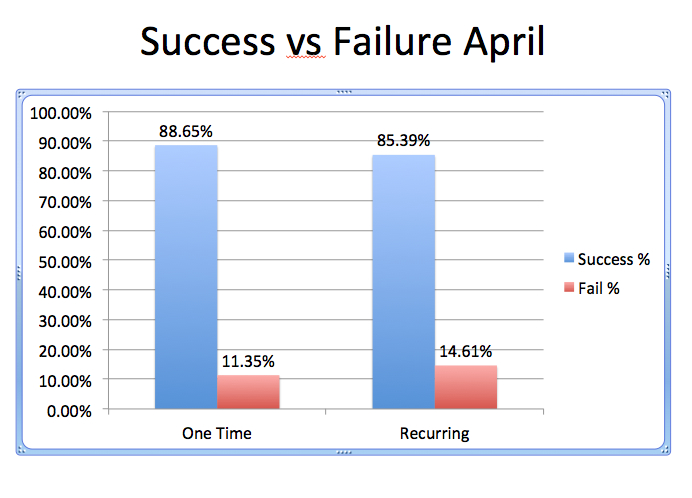
You can expect a higher success rate with one time transactions vs renewals for a number of reasons. Firstly, the card is unlikely to be out of date. Secondly, the customer is more likely to ensure they have adequate funds for the transaction in an immediate purchase. Thirdly, recurring transactions don't have a CVV (no one is allowed to store those for PCI reasons) That should not be an issue but it seems clear that some banks and gateways just don't like that fact as much.
Let's break recurring out though by gateway. Here's where it gets more interesting. I'll just pick 5 common gateways:
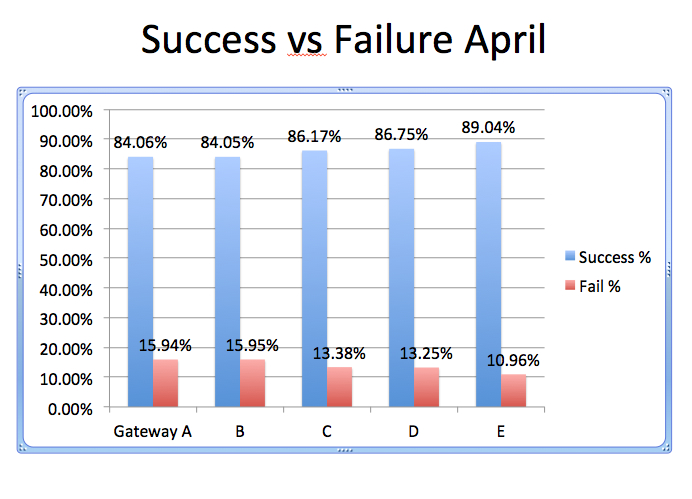
So you can see they all trade within a narrow range. But within that range there's a big difference. Customer on gateway A is seeing nearly 5 extra failures out of every 100 renewals than customer on Gateway E.
Let's look at one time transactions across 5 gateways:
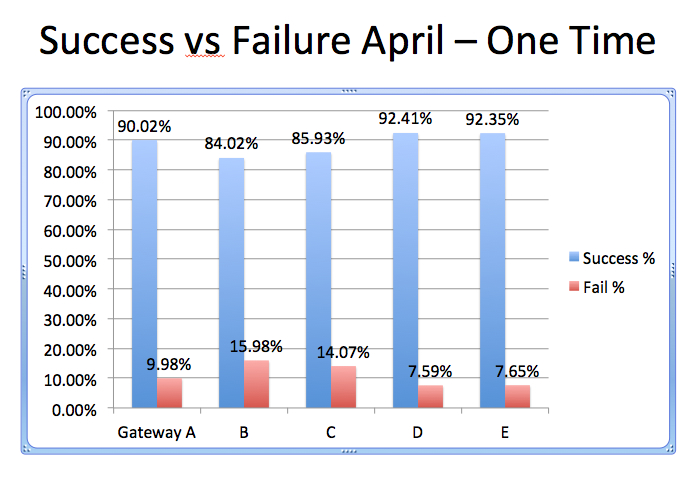
Success and Failures on one time transactions tend to trade in a much broader range. Here it seems the predicability of a recurring transaction actually helps. Maybe the card doesn't have a CVV, or maybe your customer forgot to have enough funds to cover the transaction. However, on these one time transactions the gateways/merchant accounts are applying much stricter fraud filters (after all, you're probably not going to be doing a bogus transaction on a monthly basis with a stolen card) Then the question becomes - are some doing a much better job than others? Or are some just accepting more fraud? Or is it the quality (or not) of merchant let in in the first place?
For Spreedly customers: We're happy to drill into an individual situation if you feel it would be helpful. We discovered a customer who's failure rates nearly doubled immediately after they were targeted for fraudulent transactions. We'll also continue to build out the robustness of this data as we expand and have more data (but in the short term and over time) to compare performance.
Download the Multiple Payment Gateways eBook Below

What payment gateways does Spreedly analyze in their failed transaction rate study?

Spreedly analyzes data from PayPal Website Payments Pro, Braintree, Stripe, SagePay, Authorize.Net, and Wirecard. These gateways were selected based on strong marketplace interest and good transactional volume.
Why do one-time transactions have higher success rates than recurring transactions?
One-time transactions have higher success rates for three reasons: the card is less likely to be out of date, customers are more likely to ensure adequate funds for an immediate purchase, and recurring transactions cannot include CVV data for PCI compliance reasons, which some banks and gateways view unfavorably.
What is the difference in failure rates between the best and worst performing gateways for recurring transactions?
Among the 5 common gateways analyzed, there is nearly a 5% difference in failure rates between the gateway with the highest failures (Gateway A) and the lowest failures (Gateway E) on recurring transactions, even though all gateways trade within a relatively narrow range overall.