





We’ll generally find that when people ask us how to add a second payment provider that it’s either because they’re looking for a failover backup, a better rate in a new market, or less dependence on one company. That done, they have to start figuring out what percentage of traffic to send to each provider.
Well that’s the exact reason why intelligent routing exists. You’ll want to change the equation based on the card, the customer, the market, and what specific providers handle best. We’re going to show you what intelligent routing is, how it works, and how you can use it to increase your authorization rates, as well as the means by which you’ll need to measure success.
What is intelligent payment routing?
Intelligent payment routing is the logic that decides where a transaction goes for authorization when you have more than one gateway, processor or acquirer connected. You'll also see it called smart payment routing or dynamic payment routing. It’s just different words that describe the same thing: matching each transaction to the route with the best odds of approval, the lowest acceptable cost, or both, and adjusting as conditions change.
If you only have a single gateway, there is nothing to route between. That’s why routing is usually part of a bigger payment orchestration platform that connects multiple payment gateways through one integration and stores card data in a gateway-neutral vault.
If you’re just getting started, you’ll find yourself moving along a routing continuum, starting with static rules and adding data-driven routing as volume and gateway count grow.
How intelligent payment routing works
Every routed transaction goes through the same loop, and it kicks off as soon as someone hits pay.
- When the customer pays, your checkout hands the transaction to the routing layer along with a token for the stored card, which keeps the raw card number out of your systems.
- The router looks at what it knows about the transaction, including the BIN, card brand, card type, issuing country, currency, amount and the merchant account it's coming from.
- From there it picks a path. That choice can come from rules you've set, how each gateway has been performing lately, what each one costs, or some mix of the three.
- The chosen gateway sends the authorization request through the card network to the issuer, and the issuer approves or declines it.
- If the transaction comes back with a soft decline or a gateway error, the router can try it again on a backup gateway, as long as your rules allow for that.
- Whatever happens gets fed back in, so the approval and decline data for each route helps decide where the next transaction goes.
That last step is where the "intelligent" part comes in. When a gateway's results for a particular card segment start to slip, the router picks up on it and starts shifting traffic elsewhere, so you aren't relying on someone to spot the drop and rewrite the rules by hand.
What are the different types of payment routing?
Once a transaction reaches the router, something has to decide which gateway gets the first shot at it. That decision can come from a few different places. It might be a rule you wrote months ago, live data on how each gateway's been performing, what each path costs you, or a plan for what to do when a provider goes quiet.
Each approach has its own strengths and weaknesses, and you'll usually see several of them strung together in a live setup so one can cover for another's shortcomings. Below, we'll walk through the four you'll run into most often, what each one's good at, and where it needs some help.
Rules-based routing
You set a condition and a destination. Send EUR transactions to a European acquirer. Send American Express to the gateway with the best Amex pricing. Send high-value orders to the processor with the strongest 3DS support.
Rules are predictable and easy to audit. They also go stale. Every new gateway, market or shift in card mix means someone has to revisit the rule set, and rules only know what their author knew when writing them.
Performance-based routing
Performance-based routing picks the gateway with the best recent approval rate for transactions that look like this one: same BIN range, brand, card type and issuing country. It adapts when a gateway's results change, with no one rewriting rules.
It works best with enough volume per segment. A gateway that sees only a handful of transactions for a BIN range gives the router too little data to judge, so most setups fall back to rules for thin segments.
Cost-based routing
Cost-based routing sends a transaction to the cheapest path that still meets your approval target. Processor markups, cross-border fees and scheme fees differ by provider and card type, so the same sale can cost different amounts depending on where it goes. Interchange fees set the base cost underneath all of them.
US debit adds something completely different. Since July 1, 2023, Regulation II has required issuers to enable two unaffiliated networks for card-not-present debit transactions. If your processor supports both networks, online debit can go to the lower-cost one.
Cost and approvals pull in opposite directions. A cheaper route that declines more often costs more once lost sales are counted. Set an approval-rate floor first, then cut cost above it.
Few merchants manage this today. In BCG's survey, 79% said their payments costs rose over the previous five years, and fewer than one in ten had brought them down.
Failover and cascading
Failover moves traffic off a gateway that is down or timing out. Cascading sends a soft-declined transaction to a second gateway. Soft declines, such as issuer timeouts or a generic do-not-honor response, often clear through a different path. Hard declines, such as a closed account or a stolen card, will not clear anywhere, so retrying them only adds fees.
That’s what puts the fork in the road of your retry rules. Retrying soft declines on a backup gateway helps recover declined revenue, and stopping hard declines after the first attempt keeps repeat failures out of your decline rates.
What to route on
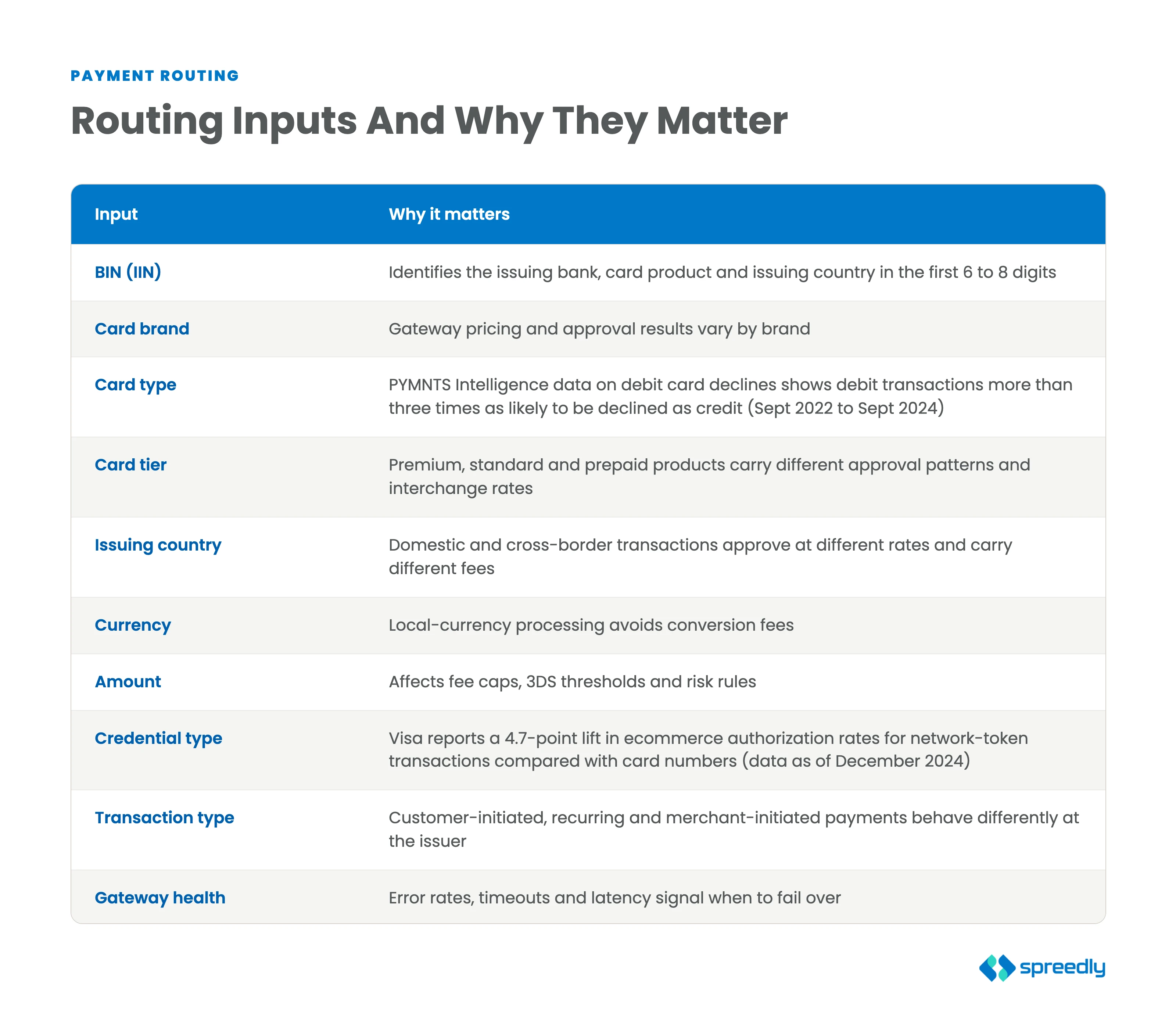
The inputs below drive most routing decisions. The more of them your router can read, the finer it can split traffic.
Benefits of smart payment routing
Every benefit of routing comes back to something specific the router is doing behind the scenes, and it helps to connect the two before you start making a case to anyone internally. Here's what you can expect to get out of it, along with what's making each one happen.
- Higher approval rates. Each transaction heads to the gateway that's been getting the best results for that kind of card lately, and if it comes back with a soft decline, it gets a second try somewhere else.
- Lower cost per approved transaction. Cost rules and your choice of debit network trim fees on the traffic where approval rates are holding steady, so you're saving money without giving up sales.
- Uptime during outages. When one provider goes down, failover moves traffic to another one and your checkout keeps running.
- Pricing leverage. Once you can move volume between providers, you've got a lot more to work with when it's time to negotiate rates.
- Faster market entry. Adding a local acquirer turns into a routing update, which gets you into a new market a lot faster.
Approval rates touch finance, engineering and operations all at once, so it's worth sorting out auth rate ownership before you start tuning routes. If nobody clearly owns it, routing changes tend to get stuck bouncing between teams.
What about international intelligent payment routing?
Selling to customers in other countries opens up a lot of revenue, but cross-border payments come with friction that domestic ones don't. When a transaction gets submitted by an acquirer outside the cardholder's home country, the issuer tends to look at it a little harder.
Its risk models flag the foreign origin, and transactions that would sail through at home are more likely to get declined. Not to mention that you end up paying for it. Card networks charge cross-border assessment fees, currency conversion adds its own markup, and the cost of each international sale creeps up even when it's approved.
International payment routing helps close that gap, and it usually comes down to three moves:
- Route to a local acquirer in the cardholder's country. When a domestic acquirer submits the transaction, the issuer sees a local payment, which tends to mean fewer false declines and better authorization rates. Local acquiring can also lower your processing costs, since you're avoiding a lot of the cross-border fees that pile up when payments travel internationally.
- Process in the cardholder's currency. Charging customers in their own currency, and settling in that currency where you can, cuts down on conversion fees and the declines that happen when the currency doesn't match what the issuer expects. It's also a better checkout experience, because customers see a price they recognize and don't get surprised by a foreign transaction fee on their statement.
- Offer local payment methods alongside cards. In plenty of markets, cards aren't how people prefer to pay. Bank transfers, digital wallets and real-time payment schemes like Pix in Brazil, iDEAL in the Netherlands or UPI in India are what customers reach for first, and putting those options next to cards at checkout helps you hold on to sales you'd otherwise lose.
Gateway and acquirer performance can look very different from one country to the next, so a provider that does great work for you in the US might be an average pick in Germany or Brazil. It's worth building routing tables market by market, using local approval rates and costs to decide where each transaction goes, and treating that work as part of your plan for new market expansion from the start.
How to measure routing performance
Once routing is live, you'll want proof that it's working, and that means tracking the right payment performance metrics in the right way. You’ll want to look at each metric broken out by route, so by gateway, BIN range, card type and issuing country, as well as in aggregate.
A blended approval rate across all your traffic has a tendency to miss exactly the thing you’re trying to solve with routing. That's how your payment analytics dashboard can look perfectly healthy while revenue quietly leaks out through a single underperforming gateway or a card segment that keeps getting declined.
Here are the payment KPIs you should be keeping an eye on, and what each one can tell you:
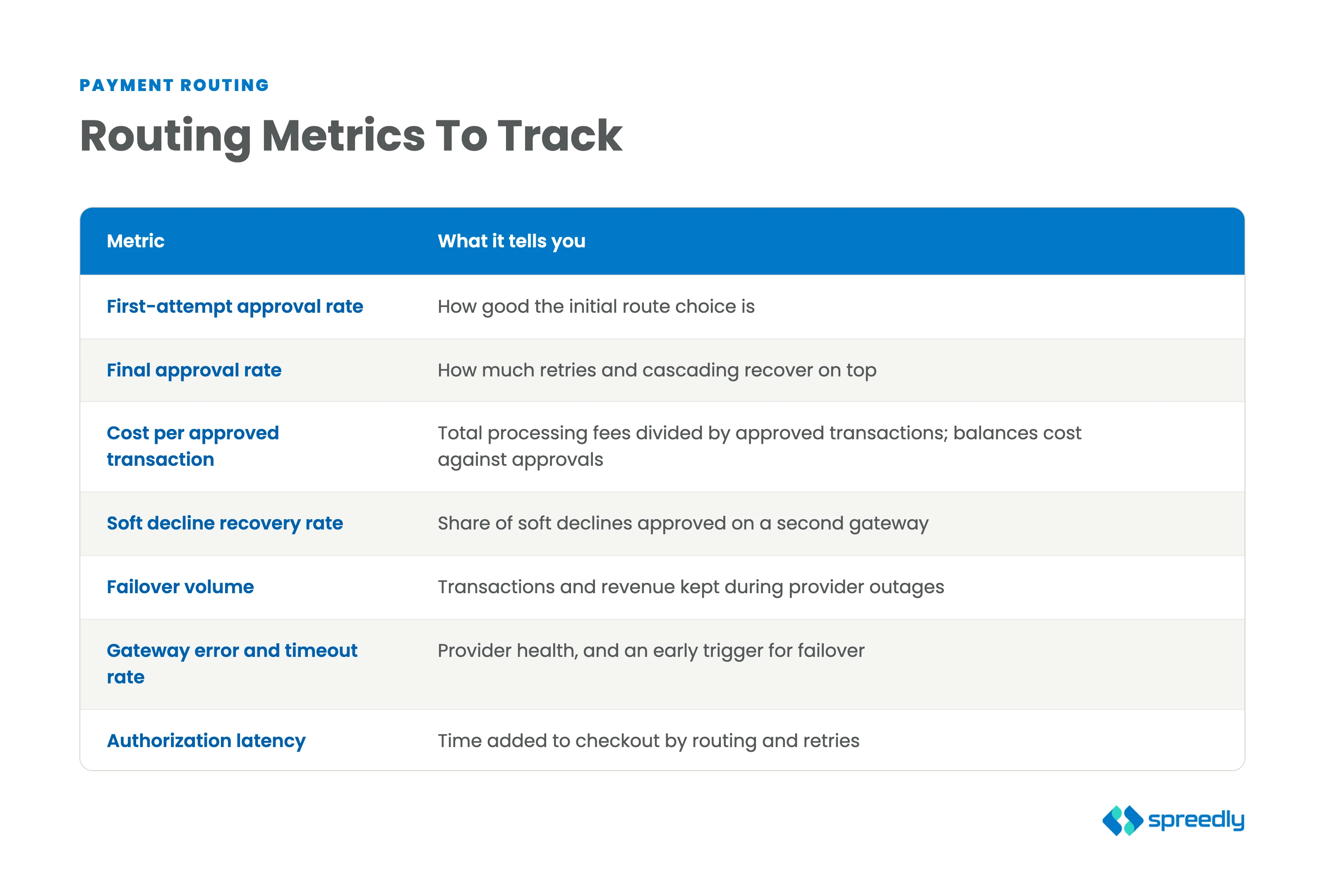
It's also important to measure all of this against a baseline, so you can see what routing's actually adding. One way to do that is to keep a slice of traffic running on your current setup as a control group and compare results over time. Another is to model what each transaction would have done if it had gone through your best single gateway. Either approach gives you a fair benchmark for authorization rates, decline rates and processing costs.
Regular benchmarking pays off here. According to BCG's survey, about half of merchants benchmark their acquirers once a year, and with routing data feeding in continuously, you can check how each provider's performing every day if you want to.
Routing with Spreedly
Spreedly connects to more than 150 gateways through one API and stores cards in a PCI-DSS Level 1 vault. A stored card can go to any connected gateway, so changing routes takes configuration and no re-integration.
Routing logic lives in Composer, Spreedly's no-code workflow builder. Payments teams design the transaction path on a visual canvas, and one workflow applies across every connected gateway. A Composer workflow can:
- Route by country, currency, card BIN or other transaction details with conditional routing rules, including separate merchant accounts per region or business unit.
- Split volume between two gateways by percentage to compare approval rates and cost.
- Fail over to a backup gateway when the primary returns an outage error, with multiple backup tiers and every failover event logged.
- Retry soft declines on a backup gateway, using Spreedly's normalized decline-code mapping across 30+ gateways to decide which codes qualify.
- Run a fraud check before authorization and trigger 3DS only when the risk score calls for it.
- Attempt a network token first and retry with the card number if the token attempt fails.
Rule changes go live on the next transaction, with no engineering ticket. Building the same setup in-house means maintaining every gateway integration, the decline-code mapping and the routing logic on top, the main cost in any build vs. buy comparison.

What is intelligent payment routing and how does it work?

Intelligent payment routing, also called smart routing, is a sophisticated process that optimizes payment processing by dynamically selecting payment gateways based on predefined criteria such as currency or geographic location. It uses advanced technologies and algorithms to analyze each transaction and select the best payment gateway or processor by considering factors like card type, banking providers, and historical transaction data to make informed routing decisions in real-time.
What are the five main steps involved in intelligent payment routing?
The five main steps are: (1) Transaction Initiation - when a customer initiates a payment and the system receives transaction details; (2) Routing Decision - where the system analyzes transaction details and applies predefined rules to determine the optimal payment channel; (3) Dynamic Routing - routing the transaction to the selected gateway, sometimes through multiple channels to maximize success rates; (4) Transaction Processing - where the transaction undergoes authorization, authentication, and settlement with the issuing bank; and (5) Feedback & Optimization - continuously monitoring performance to refine routing algorithms over time.
What are the main advantages of implementing intelligent payment routing?
The advantages of intelligent payment routing are far-reaching and include improving transaction success rates, reducing processing fees, enhancing security, and streamlining overall operations. It helps manage payment infrastructure more efficiently while ensuring your payment system functions properly.