


.svg)
.svg)
.svg)
.svg)
.svg)

.svg)
.svg)
.svg)








It's been a busy summer at Spreedly. We made agent-initiated commerce a live channel, rolled out our next-generation Checkout SDK, redesigned how network tokens get provisioned, and added a steady stream of new gateways and payment methods. Here's what shipped, what it means for your stack, and a look at what's coming next.
Supporting Payments as AI Agents Start Shopping
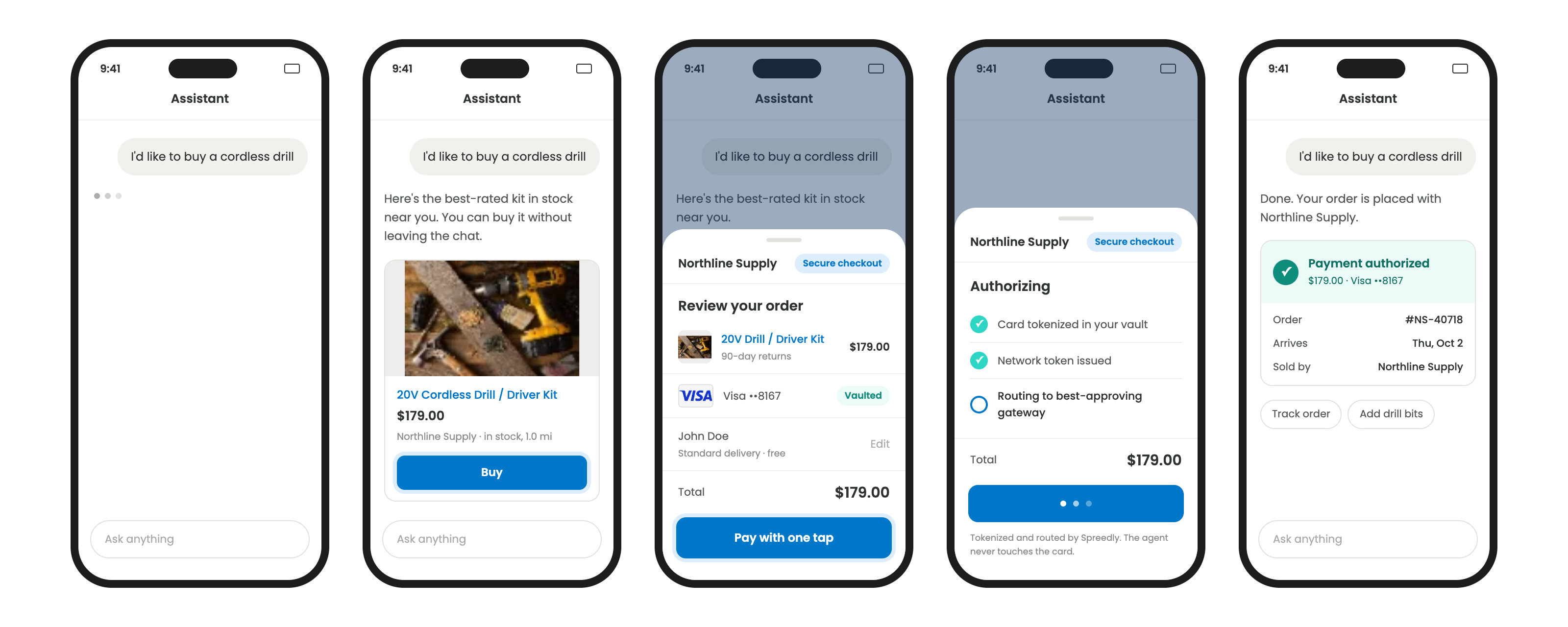
Agentic commerce started to take shape. OpenAI shipped Instant Checkout inside ChatGPT. Google rolled out its Agent Payments Protocol and brought agent-initiated shopping into Search and Gemini. Visa and Mastercard both published agent-ready rails of their own. Meta's Muse AI shopping agent has become the latest flashpoint, with checkout partnerships and a very public standoff with Amazon making headlines. Shoppers are starting to let an agent complete the purchase, not just find the product.
Spreedly has built the foundations which reaches most of the payment flows where an AI agent shows up in the transaction today:
- Your own AI agents. Any first-party use case where you want an agent in the payment flow on your own site or app runs on the Spreedly setup you already have. That extends to accepting purchases from personal AI agents acting on a cardholder's behalf, like Meta's Muse, xAI's Grok Bot, and Instinct.
- ChatGPT plugins and applications. Spreedly supports OpenAI's recommended checkout flow for merchants building on ChatGPT.
- Google Gemini and AI Shopping. For Google Pay transactions using new or stored cards, once you've configured a UCP business profile and connected your product catalogue in Google Merchant Center.
- Agent mandates. Set limits through the API and checkout SDKs so an agent only acts as intended at the moment of purchase, built to the structure of OpenAI's ACP and Google's UCP/AP2.
- MCP server for documentation. Point an AI coding assistant or agent at Spreedly's docs directly.
- MCP server for API endpoints. Tokenization and processing calls run through the same server, gated behind permissions you control.
- LLM-optimized documentation. Our docs ship in the formats agents read: AI chat, search, and markdown, alongside the standard version built for people.
What this means for you: the merchants who plug into agentic payment flows now are the ones setting the pace once agent-initiated purchases become a normal share of transaction volume, not a scramble to catch up later. Take the Agent-Ready Check to see where your setup stands today, or talk to our team to walk through what agentic commerce could look like for your business and where to start.
Checkout SDK: One Integration, Every Platform
We introduced a new version of Checkout, our SDK for Web, iOS, Android, and React Native, earlier this year. Sensitive payment data stays inside Spreedly-controlled components, so PCI-related data management stays off your plate. It comes with built-in 3DS and fraud lifecycle handling, mobile-native SDKs, and a fast-growing set of payment methods. Choose the headless integration for full UI control, or the drop-in express method when speed to launch matters more.
Since then, we've introduced more enhancements to it. Checkout now supports:
- Stripe Elements and Stripe Radar
- PayPal and Venmo via Braintree
- Click to Pay
- Bank account tokenization, as a first-class payment method
- Paze, as a third-party network token
- PayPal and Venmo on PPCP
More payment methods and platform coverage are on the way.
Approve More, Every Time: New Network Token Provisioning Lifts Authorization Rates for MIT and CIT
We shipped a dedicated endpoint for provisioning and managing network tokens (Visa, Mastercard, and Amex token references) independent of running a transaction.
Historically, token provisioning has been nested inside authorization calls: a network token only gets issued as a side effect of a live transaction. That works fine when there's a recurring charge to hang it off of, but it leaves a gap for first-time purchases and any merchant-initiated transaction (MIT) that wants the benefit of a token before the first charge runs, not after. The new endpoint decouples provisioning from authorization, so a token can be issued proactively: ahead of a subscription's first bill, ahead of a saved-card flow, ahead of any transaction at all.
What this means for you: stronger, more consistent authorization rates across both merchant-initiated transactions (like recurring billing, where the token is ready before the first charge instead of being created by it) and customer-initiated transactions (like a first-time checkout, where there's no prior authorization to lean on). It's also the kind of infrastructure agentic commerce runs on: a token ready ahead of time instead of one that requires a prior transaction to exist.
Gateway Improvements and New Payment Method Support
Adyen Async Processing Framework
We now have a new Adyen Checkout integration alongside an asynchronous processing framework, infrastructure purpose-built for payment methods where the final result doesn't come back in the initial request/response, like certain bank-redirect and delayed-settlement notifications. It comes with new European local payment methods, stored-credential support, 3DS, and network tokenization on Adyen with more APM’s and local payment methods coming soon
What this means for you: deeper, more native Adyen coverage if that's part of your gateway mix, and a foundation for supporting more asynchronous payment flows across other gateways going forward.
More Gateway and Payment Method Additions This Summer
Below isn't the full extent of what shipped. Check our developer changelog for complete details.
2C2P
- New gateway support
- GCash, VietQR, BCA Installment
- Virtual Account, PromptPay, MoMo
- DANA, Vietnamese Bank Transfer
- QRIS, True Money
- Apple Pay, Google Pay
PayPal / PayPal Commerce Platform (PPCP)
- Third-party vaulting
- Google Pay on PPCP
- Stored credentials
- Partial capture and partial refund support
Moneris
- Full Moneris REST gateway support (purchase, authorize, capture, partial capture, refund, partial refund, void, verify, store, remove)
- Apple Pay, Google Pay
- Network tokenization
- 3DS2 (Global)
- General Credit transaction type
Niubiz
- New gateway, expanding our coverage in Peru and Latin America.
Kushki
- Network tokenization
- Stored credentials
OpenPath
- New gateway support
That's a wrap on summer, and there's more already in motion.Our goal remains the same: be the infrastructure merchants run on to drive payment performance today, and can continue to count on as commerce changes tomorrow.
Questions about anything above? Reach out to our team.


.jpeg)
