


.svg)
.svg)
.svg)
.svg)
.svg)

.svg)
.svg)
.svg)









Data powered by Spreedly's Payments Intelligence Tool, pulled from transaction activity across the platform. Merchant names have been withheld.
Over the past couple of weeks we’ve all been watching payment data from the World Cup really closely. I’m no exception to that, and I got really excited about writing about how when you get enough people watching the same thing at the same time, they’re going to spend money too. Food, tickets, the rest of it.
So it seemed like a really easy target to just write about where the spikes in purchases were happening during the World cup as that’s something that transaction numbers would be able to demonstrate pretty clearly.
Not to be all sentimental about it, but I probably ended up finding out something a lot more important. Here’s how it happened.
Checking World Cup payment volume stats
I started out by looking at the obvious: six full weeks of this year's tournament. Weekend transaction volume for a set of tracked merchants ran anywhere from 21 to 29% above weekday levels, and we’ve got a story.
Food delivery platforms get slammed by watch parties, and one platform we track processed close to two million orders in a single day during the tournament, which seemed very much like exactly what I was looking for.
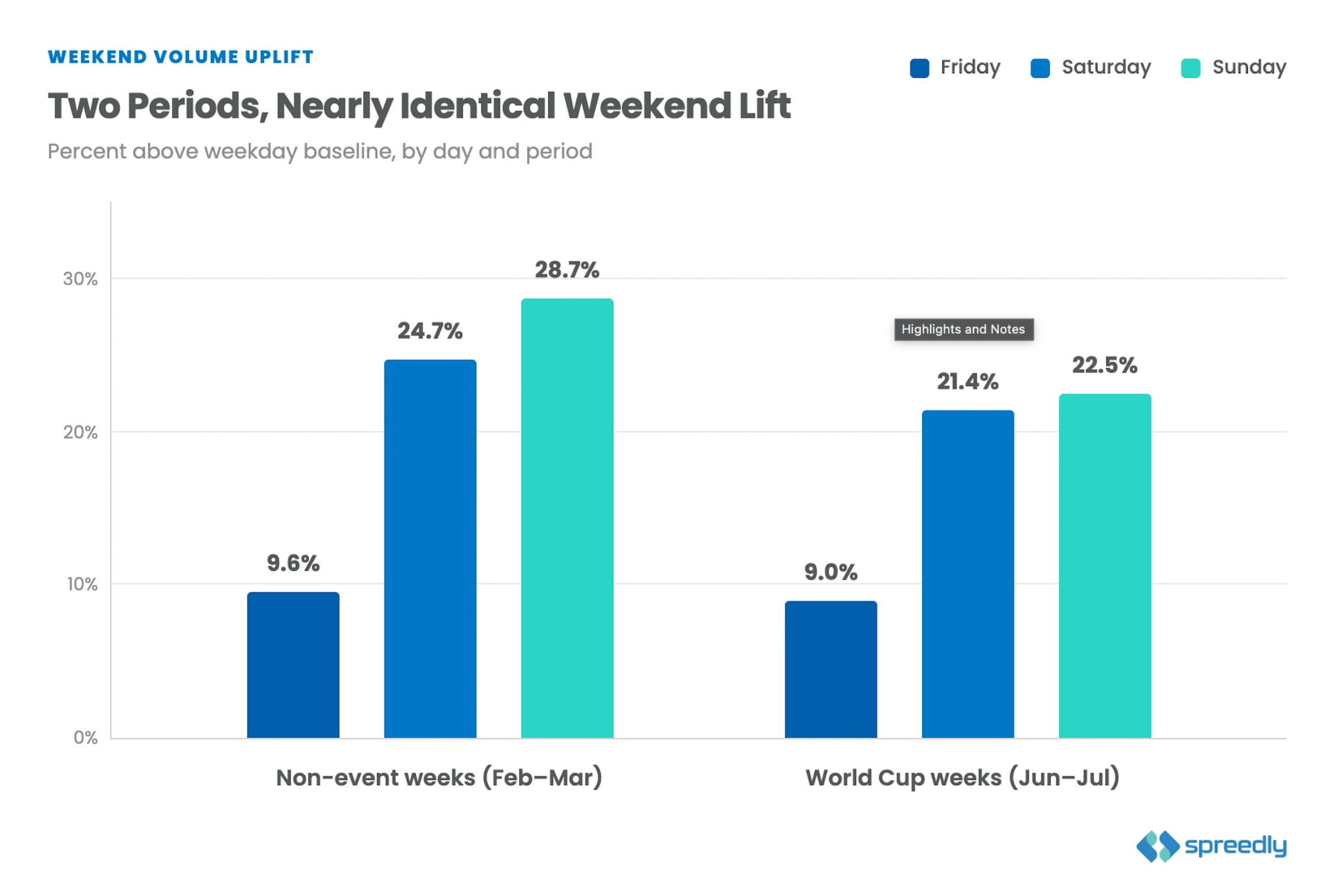
Before I started to write, I took a look at what ordinary weekends looked like so we’d have something to compare it to. So I pulled the same merchants for six weeks in February and March when nothing out of the ordinary was happening, no shared cultural event pulling anyone anywhere.
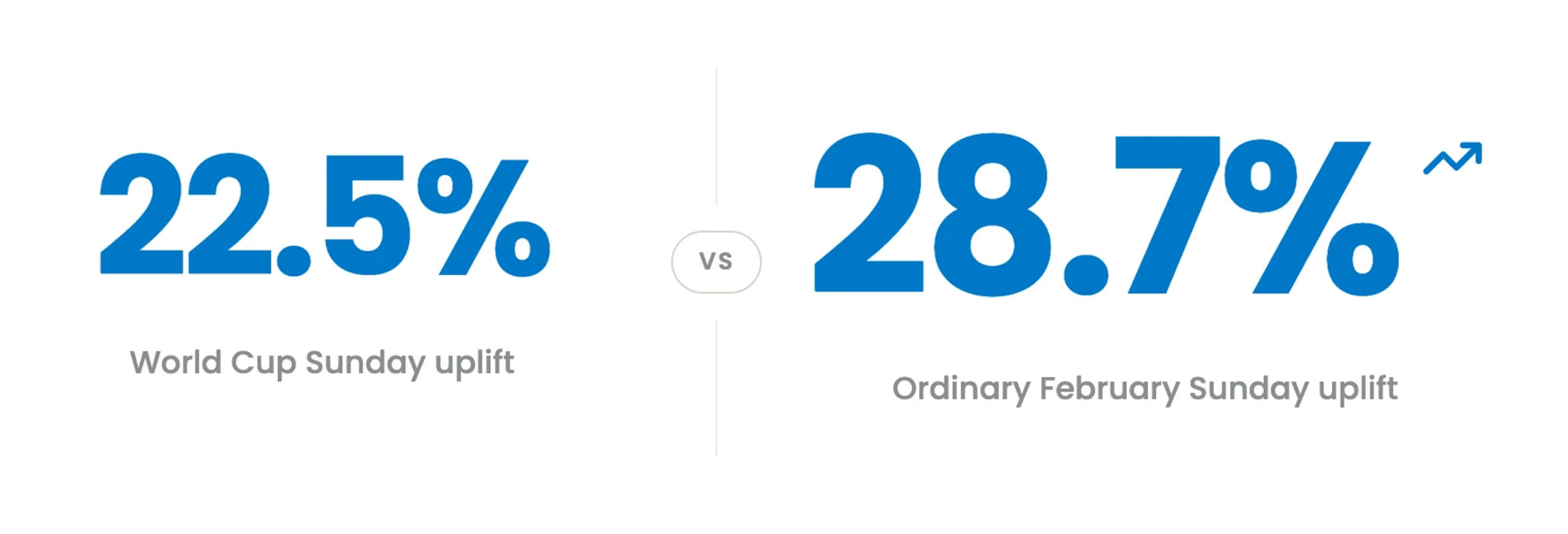
Sunday in that window ran 28.7% above weekday volume, and Saturday ran 24.7% above. Both numbers came in higher than what I'd found during the World Cup itself, where Sunday landed at 22.5% and Saturday at 21.4%.
Well, gosh darnit. If the World Cup were really responsible for an outsized weekend spike, the tournament weeks should have shown the bigger gap, not the smaller one. What I’ve actually got is data that shows some random weekend in February topped it.
I actually went back and checked the actual match schedule too, just to make sure I wasn't missing something about how the games lined up with the calendar.
The World Cup featured 104 matches across 39 (so far–I got so deep into writing this I forgot to check the score of England vs Argentina), and those matches were spread across weekdays just as much as weekends.
There was never really a reason for the World Cup specifically to create a weekend-shaped spike, because the tournament itself wasn't a weekend-shaped event other than that people are more likely to get together to watch matches on the weekends.
The not-so-glamorous takeaway is the one worth paying attention to
Here's what I actually walked away with, and I think it's more useful than the story I set out to write. A World Cup happens once every four years. A weekend happens fifty-two times a year, and apparently every single one of them carries something like a 20% or higher jump in transaction volume over an average weekday, with or without a global tournament to point to.
I'd assumed, like most people probably do, that capacity planning gets built around the peak you can see coming on the calendar.
Black Friday gets a plan (and well it should). You’ll give extra headroom to a new product launch and make sure someone is on call through the weekend. But an ordinary Saturday in March doesn't get any of that, because nothing about it looks unusual in advance, even though the transaction data says otherwise every single week.
What this means for your infrastructure
If your routing and failover only get real testing during the peaks you scheduled for, an average Saturday becomes the day you find out how they actually hold up, and you'll find out in production, in front of real customers, without any warning.
Here's what that failure usually looks like. A gateway that's handling your traffic fine on a Tuesday starts timing out or declining transactions it would normally approve, simply because more people are hitting it at once than it was tuned to expect.
If your system only ever sends transactions to one gateway, or only fails over when someone notices a problem and does something about it manually, that gateway's bad night becomes your lost revenue.
Declined payments during a busy Saturday don't feel like a minor inconvenience to a customer trying to check out. They feel like your business couldn't handle their money or that you don’t care. And you may have lost their business forever.
This is the actual argument for intelligent routing, not as your safety net, but as something doing a specific job at the exact moment volume spikes. When one gateway starts showing signs of trouble, whether that's slower response times, a rising decline rate, or an outright outage, transactions need to route to a different gateway automatically, without anyone needing to be watching a dashboard at 9pm on a Saturday to catch it.
The idea that’s important then, is that none of this needs to wait for a scheduled peak to matter. The whole point of building it into the infrastructure, rather than bolting it on before a known event, is that it's already running on the Tuesday in February nobody's watching, ready for the Saturday where something really big is happening.
Build for the weekend you already have
I went looking for a special occasion to justify the effort of testing under load, and it turns out there isn't one. The surge is just weekends being weekends, and it’s always happening, whether or not anything big is happening.
The smarter move is testing your routing and failover against that baseline directly, instead of waiting for “That Big Event” to make the case for you. You’ll be glad you did!

Does the World Cup actually increase weekend payment volume?

Not more than an ordinary weekend already does. Tournament-window weekends ran 21 to 22% above weekday levels, while a comparison stretch with no major event running came in at 25 to 29% above, higher in both cases.
Why does this matter if the World Cup isn't the cause?
Because the surge shows up every week regardless of the cause, and infrastructure built only around scheduled peaks like Black Friday ends up missing a recurring weekend pattern that's bigger than most teams plan for.
What should merchants do with this?
Test routing and failover against ordinary weekend volume, not just the seasonal peaks everyone already expects. The baseline itself is where the real risk is hiding.