

.svg)
.svg)
.svg)
.svg)
.svg)

.svg)
.svg)
.svg)








Data powered by Spreedly's Payments Intelligence Tool, pulled from transaction activity across the platform. Merchant names have been withheld.
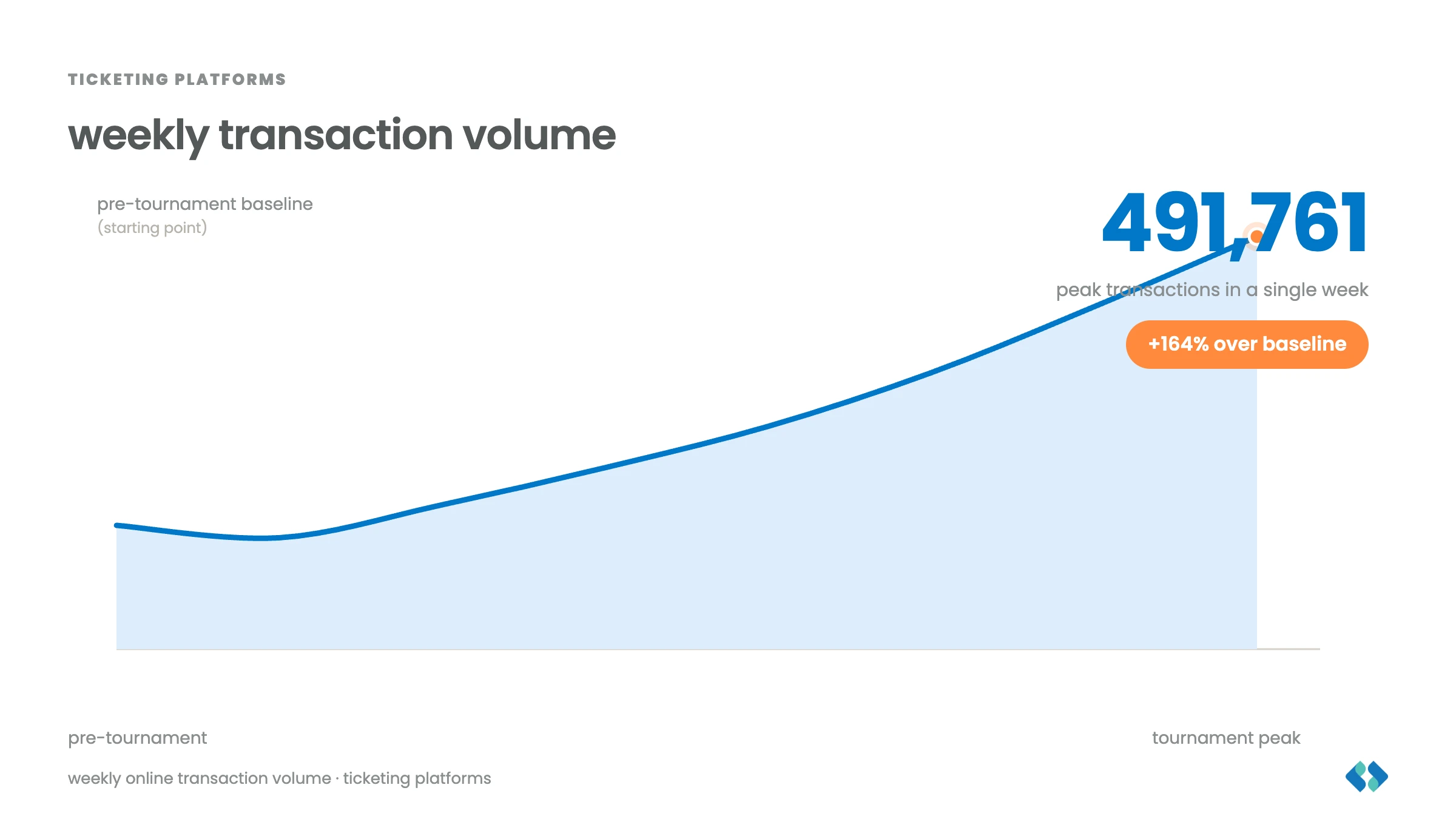
While you were on the edge of your seat watching your favorite team during the World Cup group stage, ticketing platforms were busy handling 491,761 transactions over the course of a single week.
Pretty, pretty, pretty good given that it's 164% up from the pre-tournament baseline.
As it turns out, this is the first domino in a very long line. Everything a fan buys next, from flights to snacks, runs through its own separate piece of payment infrastructure, at the same time, for millions of people. So let's take a closer look.
Day one: the ticket gets bought
As soon as that bracket goes live, you’ll hear the sound of laptops being opened while fans start refreshing ticketing platforms' checkout pages. Weekly transaction volume across ticketing platforms climbed 164% over baseline that week, cresting at 491,761 transactions, a number driven almost entirely by fans trying to make sure they get to be there for the teams they most want to see.
Ticketing platforms often run high volume through one or two dominant gateways, so there's not a lot of wiggle room when it comes to spreading the load when demand spikes.
If you have just one gateway active and it goes down during an on-sale window, you end up with thousands of fans seeing a decline screen instead of a confirmation page. It's the reason ticketing platforms rely so much on infrastructure built to keep customers transacting even when a single provider goes down under the weight of people across the globe trying to buy the same seat.
A lot of those tickets get bought on a Saturday, which tracks. Weekend volume for ticketing runs higher than weekday volume anyway, a pattern that spikes every week, tournament or not. This week, though, that weekend bump stacks directly on top of the tournament's own 164% surge.
Two weeks later, the itinerary comes together
If you live in Amsterdam and just bought a ticket to see the Netherlands play in Dallas, unless you have either a private jet or a fast sailboat, you’ll probably need to book a flight and somewhere to stay.
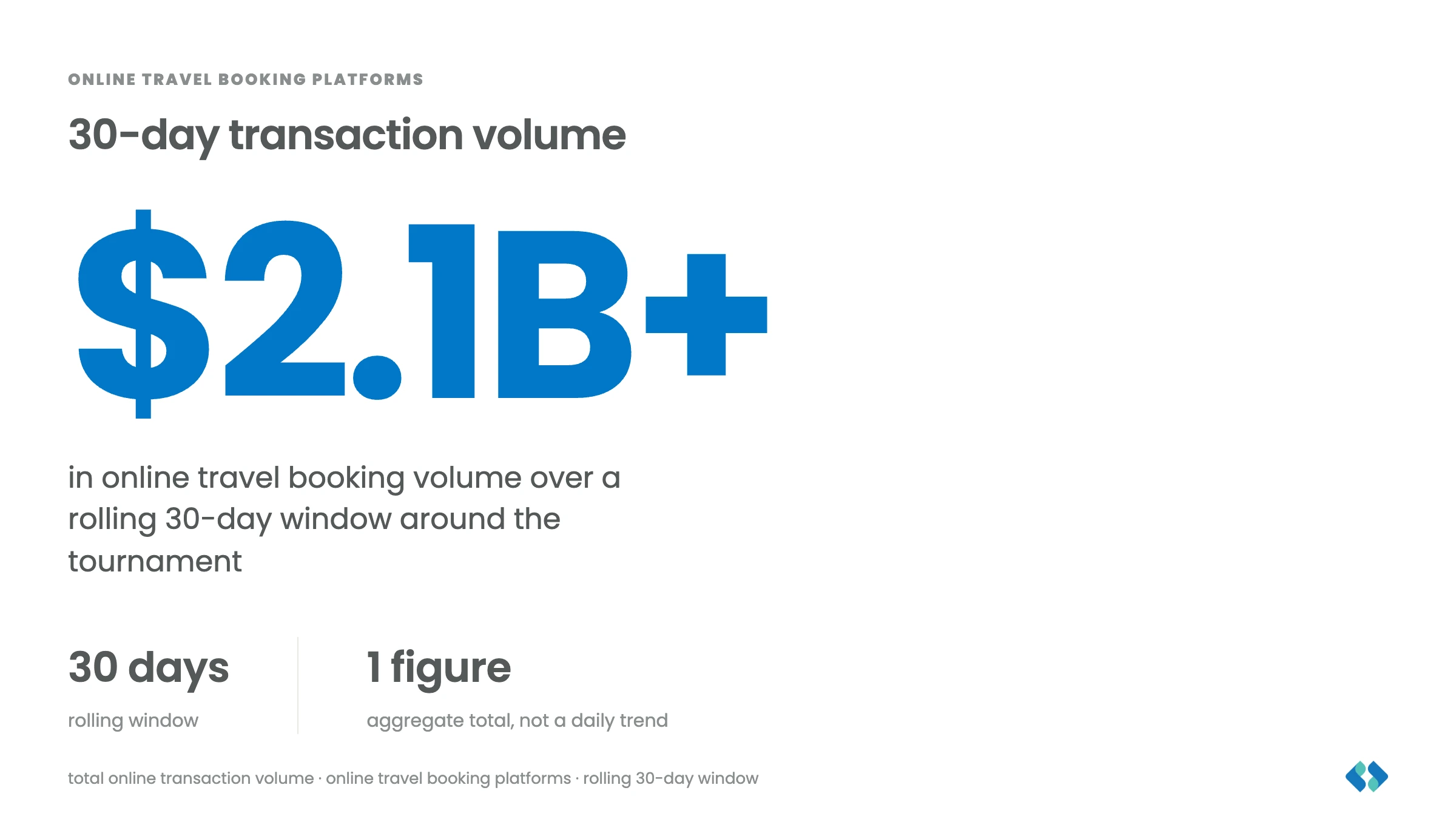
Online travel booking platforms recorded more than $2.1 billion in transaction volume over a 30-day window around matches like these, roughly the GDP of a small nation, assuming that nation's chief export is regret over middle seats on 11-hour flights.
Because of the global nature of the tournament, a lot of this spending has to cross currencies and unfamiliar issuer-acquirer relationships, even when it's running through the same card networks the whole time. Cards issued in fans' home countries are clearing hotel bookings priced in other currencies, routed through processors that don't usually see that particular combination of bank and network.
To keep those legitimate purchases from bouncing just because two systems couldn't agree on how to talk to each other, intelligent routing sends each one to whichever gateway will actually clear it.
It's also why the same cards get tokenized once and reused for rental car bookings a couple days later instead of retyped from scratch. Now we’re cookin’ with oil!
Kickoff day, plan A: staying in
Once we get to the actual match days, we start to see where the plans got split. Not everyone can get to the big game, so they’ll be watching on TV, ready for every corner and every commercial break hydration break.
On the single biggest watch-party day of the tournament, a leading Latin American food delivery platform processed up to 1.98 million transactions, which means that a fairly remarkable number of fans created chaos in commercial kitchens across the continent within the same four minutes.
In the LATAM region, a large share of that volume runs through local bank transfers and digital wallets rather than international card networks, so the rail carrying tonight's orders looks nothing like the rail that cleared the flights two weeks earlier.
If a payment provider so much as sneezes at that volume, the platform needs automatic failover ready to reroute orders to a backup gateway before halftime snacks turn into a hangry customer service queue. The stored cards from the ticket purchases don't help here either. These orders run through a different app and a different rail entirely. Nevertheless, they got it done, much to the delight of those hungry football fans.
Kickoff day, plan B: the theater down the street
Did you know that you can go to a theater and watch World Cup matches? That is something the writer of this post was not aware of until they started writing. Seems like everyone else knew, though.
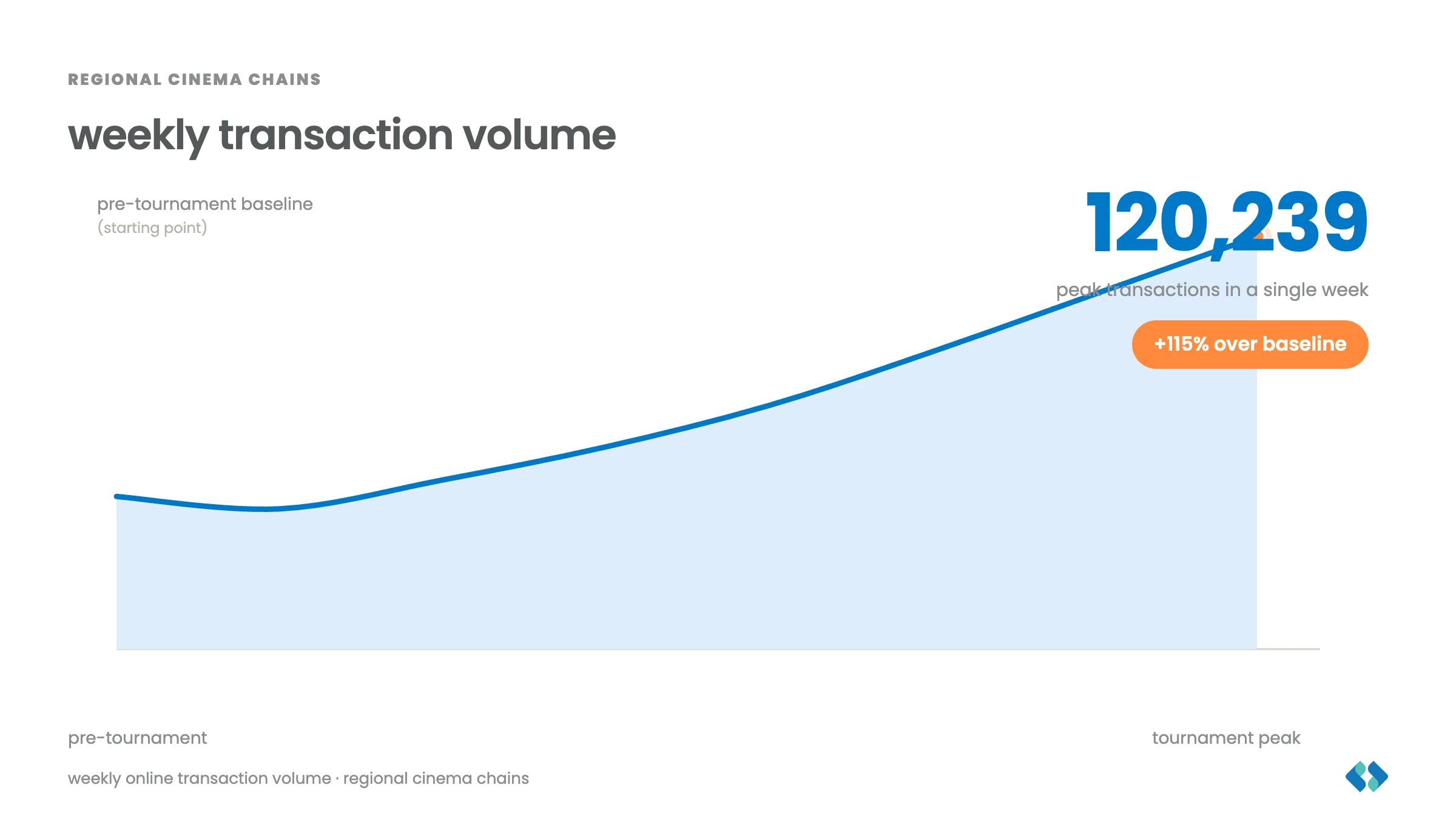
Regional cinema chains saw weekly transactions climb 115% during the tournament, peaking at 120,239 in a single week, proof that plenty of fans will pay theater prices for popcorn just to watch a match on a screen the size of a building.
Buying those cinema tickets a few hours before showtime puts fans through a smaller, faster version of the same crunch from day one, just compressed into a couple of hours instead of a multi-week on-sale window. A cinema chain's checkout only has to hold up under that kind of pressure a handful of nights a year, and this is one of them.
What actually holds this together
Over the course of one tournament, fans touch four different pieces of payment infrastructure: a ticketing platform concentrated on one or two gateways, a cross-border card transaction, a local bank transfer, and a cinema box office running its own short, compressed on-sale window.
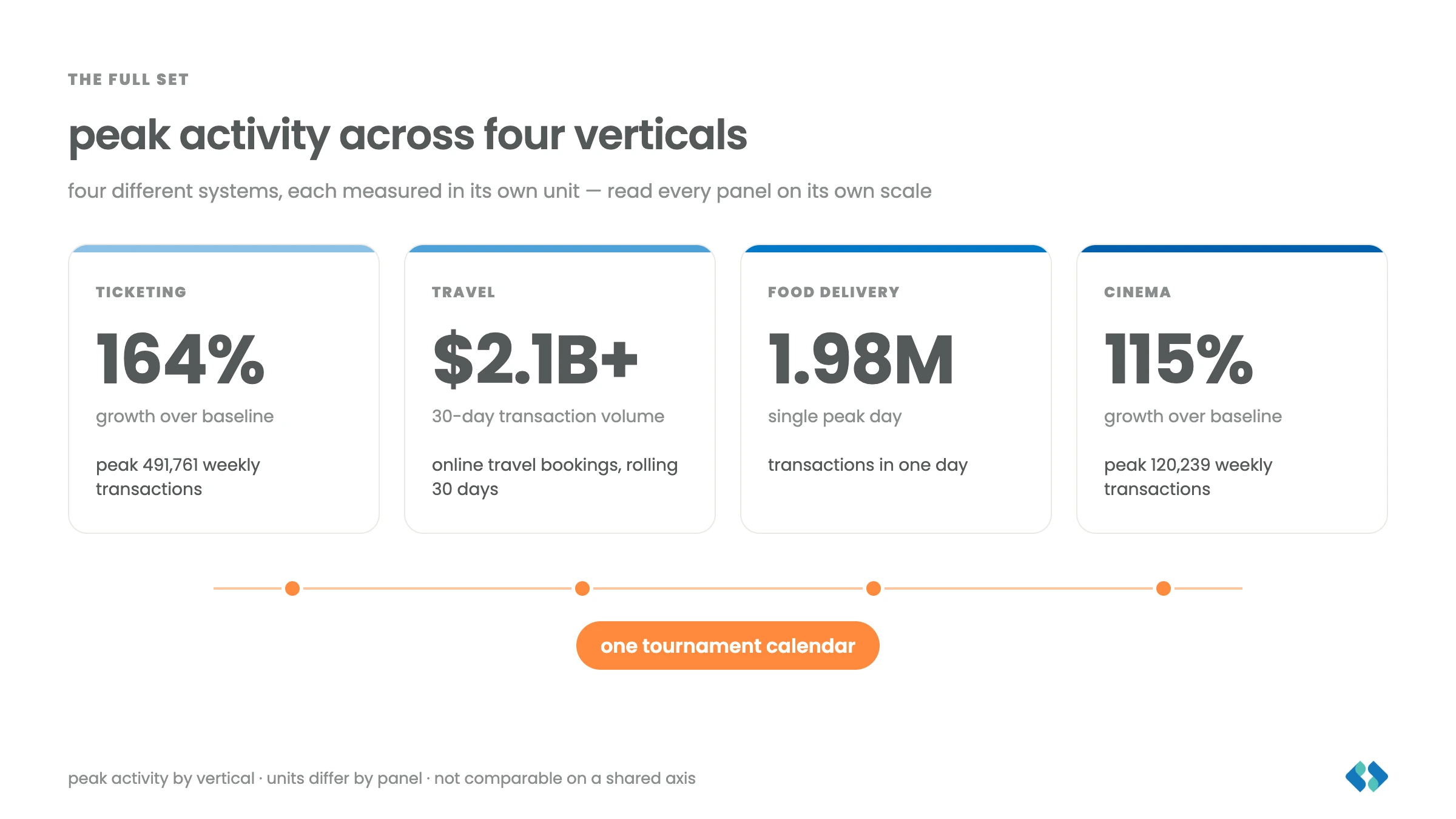
The stats add up to something bigger than any single purchase. A World Cup turns into dozens of unrelated businesses getting stress tested within days, sometimes hours, of each other, for entirely different reasons. The platforms that come out fine on the other side usually have one thing in common: payments orchestration built to handle everything fans buy, not just the ticket that started the trip.

Why do payment failures spike during major global events?

Major events like a World Cup or a holiday sale compress months of normal demand into a few high-traffic days. A business running high volume through a single gateway or processor has less room to absorb that spike, which is when declines and outages become more likely.
How can a business prepare for a sudden spike in transaction volume?
The most reliable way is to avoid depending on a single payment gateway or processor for high-volume periods. Businesses that can automatically reroute transactions to a backup provider hold up noticeably better when demand spikes without warning.
Why do some businesses use more than one payment gateway?
Relying on a single gateway means an outage or a failed authorization has nowhere else to go. Businesses running high transaction volume typically route payments across multiple gateways so a backup provider can pick up the load automatically if one gateway slows down, and so they can accept different card networks or local payment methods without rebuilding checkout for each one.