


.svg)
.svg)
.svg)
.svg)
.svg)

.svg)
.svg)
.svg)










They're already in your vault, sitting there, waiting to wreak havoc on your subscription billing. They're called zombie tokens, and they're exactly as scary as they sound.
We're talking about payment credentials that are no longer tied to active customer relationships, haven't touched a successful transaction in months, and are still being counted against your vault bill every single day. The invoice is only the first place they're costing you, because the same dead credentials feed failed rebills, which already account for 20 to 40% of all subscription churn, while inflating your compliance costs and corrupting your analytics on the side.
This post is about going zombie hunting. We'll give you a framework for finding your zombie tokens, calculating what they're actually costing you across billing, churn, and compliance, and understanding what vault architecture designed to prevent the problem looks like. Let's go!
How zombie tokens differ from expired cards, stale credentials, and churned customers
Not every dead-looking credential is the same thing, and it's worth knowing the difference before you start going all Walking Dead on your vault.

An expired card isn't necessarily gone forever. Account Updater or network tokenization can pull the new card details automatically and keep billing without anyone noticing. A stale credential is one that hasn't been touched in a while but might still work if you tried it. A zombie token is what you're left with when neither of those fixes applies, because the credential is just dead.
A churned customer's payment method is the clearest example. The customer cancelled 14 months ago, the subscription platform stopped billing them, but nobody ever deleted the token. It's still sitting in the vault, still counted in your total, and still adding to your PCI audit surface area without generating a single dollar. The triage rule is simple: expired cards get refreshed, stale credentials get a second look, and zombie tokens get removed. Knowing which bucket a credential falls into tells you what to do next and what it's been costing you.
Five reasons this problem is more expensive than your invoice suggests
The invoice is the cost you can see, which makes it the least interesting one. Zombie tokens drag on billing, revenue, compliance, and analytics all at once, and most of those costs get blamed on everything except the vault where they actually live. That's the thing about the undead, they don't show up on the security cameras.
At-rest billing models charge you for storage regardless of activity
Plenty of vault providers count every token in your database toward your monthly bill, whether that token processed a transaction yesterday or has been gathering dust since two CFOs ago. It's the hotel minibar of pricing models, where you pay for what's in the fridge whether or not you ever touch it. At one million tokens with more than half of them inactive, the cost gap between an at-rest model and a model that charges only for active tokens can exceed 40 percent annually. The architecture you want charges you when a card is doing actual work, and treats storage as what it is, which is a rounding error for the provider and a hostage situation for you.
Failed recurring payments drive involuntary churn
When your subscription platform tries to rebill a zombie token, you don't just get a failed transaction. You get a potential churn event, a support ticket, and a dunning workflow that eats engineering and operations time, all triggered by a card that was never going to work in the first place. ProfitWell's founder calls this kind of churn "absolutely needless," and a dead credential is the most needless version of it, since it's the one failure with a 0% recovery rate. The revenue lost this way almost never gets attributed back to the vault, which is exactly why it stays invisible. It's the leak in the basement that shows up as a water bill that just gets paid with everything else.
Stale tokens inflate your PCI audit surface area
Every zombie token that maps back to a cardholder and sits in an in-scope system is another thing your QSA has to evaluate, and QSAs bill like lawyers. Level 1 assessments run $25,000 to $100,000 or more annually according to Feroot's 2026 analysis, and that number scales with the size and complexity of what's being audited. Credentials that should have been redacted years ago are costing you assessor hours and remediation effort for zero business benefit, so actively redacting dead tokens is one of the most direct ways to shrink that bill.
Zombie tokens pollute your vault analytics
Imagine 30% of your stored credentials are functionally dead. Your authorization rate calculations, your lifetime value models, and your customer identity resolution are all drinking from a contaminated well, and decisions made on that data come out directionally wrong in ways that are nearly impossible to trace back to the source. The authorization rate that looks like a payment performance problem may actually be a hygiene problem, because you're calculating declines across a denominator stuffed with thousands of credentials that never had a chance of succeeding. You've been grading the test wrong the whole time.
The cleanup cost compounds with delay
Every month a zombie token sits in your vault is another month of billing, another doomed rebill attempt, and a slightly bigger mess waiting at the end. Teams that clean up early treat it as routine maintenance, the vault equivalent of changing the oil. Teams that wait end up with a full migration project, complete with cross-functional coordination, dedicated engineering resources, and a freeze on vault changes while the work happens. Zombie movies work the same way, since the survivors who board up the windows in act one always fare better than the ones who wait until the horde is on the lawn. This is the rare payments problem where doing nothing is the most expensive option on the menu, and the price goes up every month you study it.
How to find the zombie tokens in your vault
There isn't a single source of truth for zombie token accumulation. You'll get the best picture from combining vault data, billing records, and decline history. Fortunately, the audit is more straightforward than most teams expect once they know where to look.
Start with your own transaction data
The most direct audit starts with the last_successfully_used field on your stored payment methods. Filter for credentials where this date is more than 90 days in the past and cross-reference against active subscription or billing records. The gap between total stored tokens and tokens with recent successful activity is your starting estimate for the inactive tail.
This field isn't always available or populated by default, and if your vault can't surface it natively without custom instrumentation or expensive LIST calls across your full vault, that's itself a meaningful signal when evaluating vault architecture. A vault that can't tell you when a card last worked is a vault that can't tell you what's alive in there.
Pull in your billing and subscription records
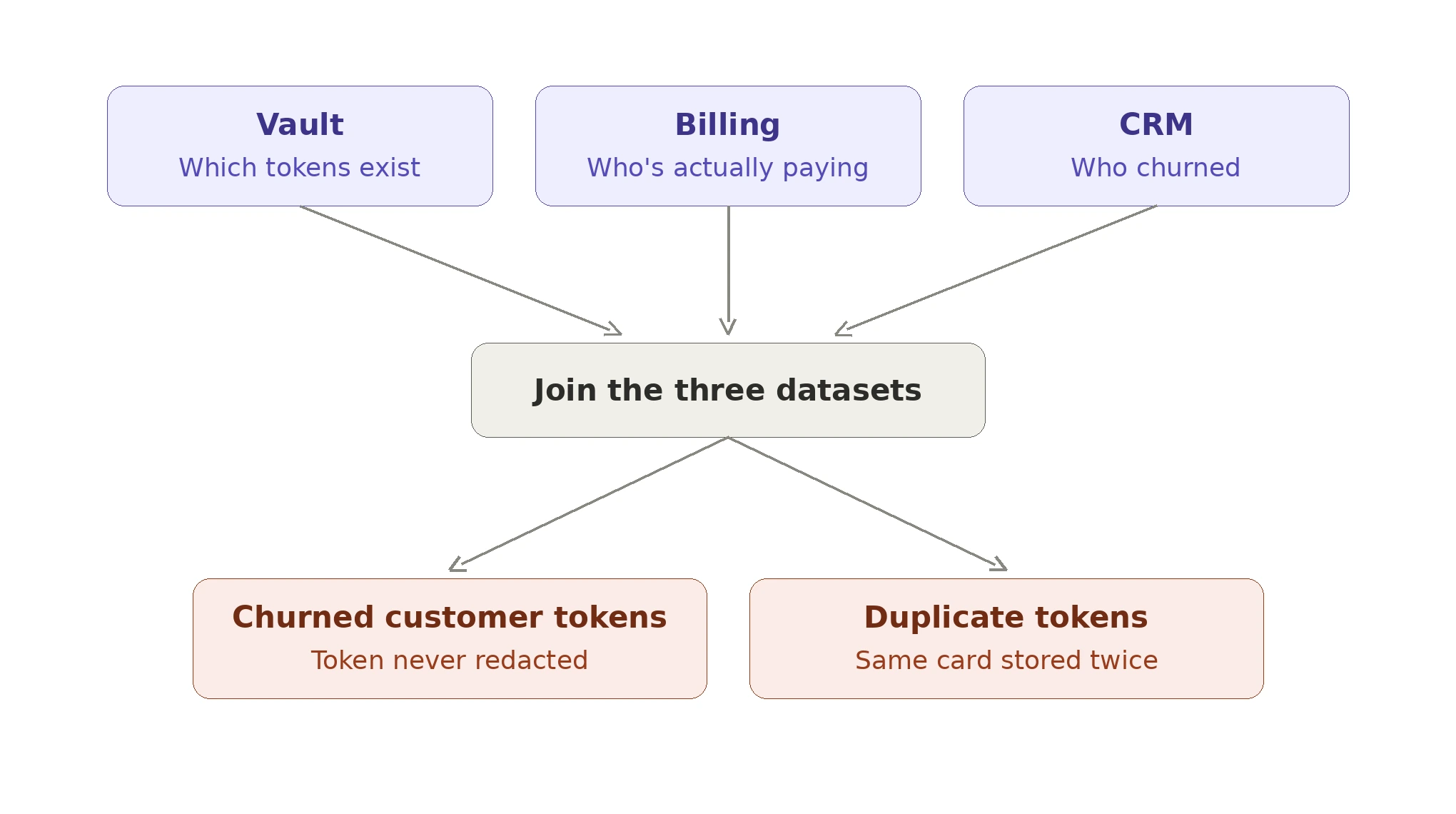
Your vault, your billing system, and your CRM are each sitting on a piece of the truth, and none of them talk to each other unless you make them. The vault knows which tokens exist, billing knows who's actually paying you, and the CRM knows who packed up and left months ago, so when you join those datasets you finally get a clear picture of which stored credentials are attached to living, breathing revenue and which ones are just squatting in your vault.
That cross-functional audit tends to surface two kinds of zombie that a vault-only review will never catch. The first is the token belonging to a churned customer, where someone dutifully closed out the subscription record but nobody ever went back to redact the credential, leaving it to haunt your storage like a gym membership you forgot to cancel. The second is the duplicate, where an active customer's card got stored two or three times across different integration points because each one was vaulting independently. Neither type is doing you any favors, and both are padding your token count and your invoice.
Review your decline and retry data
If a stored card keeps getting declined and hasn't produced a single successful payment in 60 days, it's dead. Your billing system just hasn't noticed, so it keeps swinging away like a boxer who didn't hear the bell. When teams actually look at their decline codes on recurring billing, they routinely find that 10 to 15 percent of active billing attempts are running against cards that haven't worked in months. No amount of clever routing fixes that, because it's a hygiene problem, and the fix is a mop.
Map your vault against a lifecycle management framework
Here's a simple way to grade your vault. A passive vault is a storage unit. You put cards in, you take cards out, and nobody asks questions. An active vault is more like a good property manager. It knows which tenants are current, which ones moved out, and which units need attention, and it acts on that information without waiting for you to ask. If your vault is the storage unit kind, you're collecting zombie tokens by default, because nothing in the system is built to notice them, let alone show them the door.
Use vault analytics tooling to surface what manual review misses
A quarterly manual audit catches problems four times a year. Analytics tooling catches them every morning. A daily dashboard that tracks changes in your enrolled card counts and pings you when something jumps turns vault hygiene from a dreaded seasonal chore into background maintenance, and small problems get caught while they're still small and cheap. Zombies are a lot easier to deal with one at a time.
What a self-healing vault looks like in practice
The zombie token problem isn't inevitable. It's what happens when a vault is built to store things rather than manage them, so the fix is architecture that handles credential lifecycle on its own, without waiting for a quarterly audit to come along with a flashlight. In practice that comes down to five capabilities working together, and once you've seen them in combination it's hard to take a vault seriously without them.
The first is automated Account Updater, a handy tool that keeps stored card details current as the world changes around them. Cards expire, get replaced after suspected fraud, or get reissued wholesale in a brand swap event, and instead of those moments turning into failed rebills, the update arrives from the network and gets applied to the stored token before anyone notices anything happened. The subscription keeps running, the customer stays blissfully unaware, and that invisibility is exactly how payments should feel.
Network token lifecycle management takes the same idea further by swapping the stored PAN for a network-issued token that maintains itself across its entire life. Because the token represents the underlying account rather than one specific card number, a reissuance event that would kill a PAN-based credential passes through a network token like weather, and your billing never even feels the breeze.
Then there's the matter of all the copies. Duplicate detection and unenrollment catches the same underlying card account that got stored two or three times across different environments or integration points, removes the redundant versions, and keeps the canonical token, which in many implementations trims the vault count by 20 to 25 percent before you've touched a single genuinely dead credential.
For the credentials that really are dead, custom redaction rules automate the cleanup that manual audits always catch too late. You can set the vault to redact tokens that haven't successfully processed in a defined window, that belong to accounts your billing system marked as churned, or that have failed a threshold number of consecutive update attempts, and from then on the cleanup just happens. Think of it as a self-cleaning oven, except this one actually works.
The last piece ties it all together: health monitoring that turns reactive auditing into continuous visibility, with a daily deviations dashboard flagging unusual swings in enrolled card counts so your payments operations team gets the signal while a problem is still small and cheap rather than large and on the agenda.
Putting the zombie token audit to work
Running the audit is the easy part. The harder part is knowing what to do with what you find, and who needs to see it, because the audit produces three different stories for three different audiences.
Deciding which credentials to act on first
Not every dead token is equally urgent. Start with credentials attached to recently churned high-value accounts, because every one of those is compliance exposure with nothing to show for it. Move next to the cards generating repeated declines on live billing cycles, since those are racking up retry fees and annoying customers you'd very much like to keep. Everything else, the genuinely inactive stuff with no billing attached, can go into a scheduled cleanup that runs as part of normal vault operations.
Making the internal case for vault investment
The audit hands you three numbers that finance will actually understand: what you're overpaying each year to store dead tokens, the revenue you're losing to failed recurring payments on stale cards, and the audit costs you're carrying because your PCI scope is bigger than your business. Add them up and you've got a business case that doesn't require anyone in the room to know what a vault is.
And here's the framing that wins the budget conversation. Instead of asking for money to prevent some hypothetical future problem, you're pointing at money leaving the building right now and offering to close the door.
Identifying whether your current vault architecture is producing the problem
Two setups breed zombies faster than anything else. The first is gateway-bound tokenization, where your tokens live with one processor and your lifecycle tools are whatever that processor felt like building. The second is the passive independent vault, which stores everything and manages nothing. The quick test is this: if your vault can't tell you when a card last worked, can't automatically redact dead credentials, and won't alert you when your card counts do something weird, you're growing zombies faster than you're finding them.
It's worth saying the unpopular part out loud. A processor that owns your tokens benefits from the pile getting bigger, because every token in their vault is one more reason leaving feels impossible. An independent vault wants the same things you do: clean data, an accurate bill, and a token count that reflects your actual business instead of its archaeological record.
Deciding where to take the findings
The audit does its best work when it lands on three desks at once. Finance gets the billing and PCI scope numbers, the billing and subscription team gets the churn attribution, and engineering and product get the verdict on whether the current vault can actually do active lifecycle management. Keep those findings inside the payments team and you've got an interesting internal report. Present them together as one unified cost picture and you've got a budget approval.
Your vault should reflect your active business, not its history
Your PSP built your vault to keep you in it. Every zombie token in there is another reason migration feels too hard, another invoice line nobody can explain, and another month of paying for a problem your vendor has no reason to fix. Run the audit, put a real number on the dead weight, and find out what staying put is actually costing you. Happy hunting.

What is a zombie token?

A zombie token is a stored payment credential that's no longer tied to an active customer relationship, isn't being used for billing, and contributes nothing to revenue while still counting toward your vault bill. Unlike an expired card, which can be refreshed automatically, or a stale credential, which might still work, a zombie token is past saving. The most common example is a churned customer's payment method that was never redacted after their subscription ended.
How do I find zombie tokens in my vault?
Filter your stored payment methods for credentials with no successful transaction in the past 90 days, then cross-reference against active billing and subscription records. Joining vault, billing, and CRM data surfaces the zombies that vault-only analysis misses: tokens belonging to churned customers and duplicates stored across multiple integration points. Repeated declines with no successes over 60 days are a third reliable signal.
How much do zombie tokens actually cost?
The cost shows up in four places: vault overbilling that can exceed 40 percent annually under at-rest pricing models, involuntary churn from failed rebills (which drives 20 to 40% of all subscription churn according to ProfitWell), expanded PCI audit scope on assessments that run $25,000 to $100,000 or more annually, and polluted analytics that skew authorization rate and lifetime value calculations.