










Would you let an AI pick your brands if it could consistently save you 20% on purchases? We asked 2,000 US adults that in our State of Checkout 2026 survey, run by Talker Research from September 3 to 8, 2026. Sixty-three percent said they would or might, 27% yes and 36% maybe.
Once the agent does the choosing, the brand you spent years building stops holding the customer. The transaction does. As merchant of record, you still own the sale, the refund, the chargeback, and the customer record. The catch is keeping that status on every agent surface, and that means not running every agent transaction through one processor.
What a Merchant of Record Is, and Why Agents Raise the Stakes
A merchant of record is the business that sells to the customer and accepts the payment. Its name appears on the card statement. It holds the relationship with the acquirer and is responsible for the transaction, including refunds, chargebacks, and card network rule compliance.
Merchant of record vs payment processor comes down to one difference. The processor moves the money, and you own the sale. The processor works on your behalf, but the obligations to the customer and the card networks stay with you.
AI agents don’t change the merchant of record meaning. They change how much rides on it. A shopper can now find a product, compare it, and decide to buy without ever leaving ChatGPT or Gemini, and you don’t run either of those. What you still hold is the transaction and everything that happens after it.
The companies behind ACP and UCP say the same thing in their own documentation. They both want you to adopt their protocol, so they aren’t neutral. On this point, though, they agree.
The Agentic Commerce Protocol, from OpenAI and Stripe, says “With ACP, businesses maintain their customer relationships as the merchant of record.” The Universal Commerce Protocol says “the business typically acts as the Merchant of Record (MoR), retaining financial liability and ownership of the transaction.”
Better yet, neither one locks you into a single processor. ACP says you can use it “with any compatible PSP.” If you want the two protocols side by side, read ACP vs UCP: Don’t Bet Your Payment Stack on One AI Agent.
Brand Loyalty Is Now Conditional
We also asked people what they’d give up if an AI consistently found them the best products at the lowest prices. They could pick more than one answer. Brand loyalty was the pick for 34% of Gen Z and only 15% of Boomers. Millennials landed at 30% and Gen X at 20%.
Look at who’d give up nothing and you see the same divide from the other side. Only 31% of Gen Z would keep every one of those decisions for themselves, compared to 61% of Boomers.
In the report’s words, Gen Z “already treats brand loyalty as conditional.” The timing is what should worry you. Gen Z and Millennials are heading into their peak earning and spending years, so the shoppers with the most money ahead of them are the least attached to your logo.
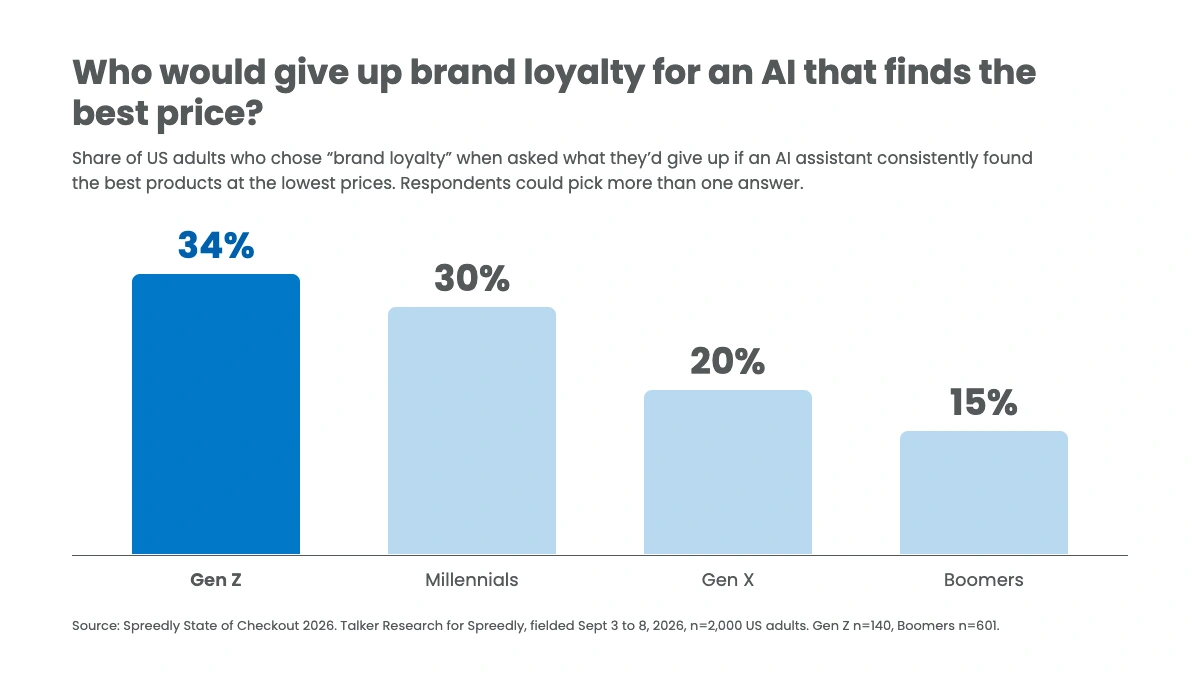
If shoppers stop being loyal at the agent, you have to win them back at the transaction. That means the refund that actually lands, the dispute that gets resolved, and the receipt with your name on it. The agent doesn’t do any of that. You do, as the merchant of record.
Shoppers already see the payment as theirs. In the same survey, 41% said they’d still insist on picking their payment method even if AI kept saving them money. They’ll let an agent choose the product before they let it take over the payment relationship.
Liability Is the Relationship
So who’s the merchant of record when an AI agent makes the purchase? You are, if you’re the one selling the goods. OpenAI’s Agentic Commerce in production guide is direct about it: “Your platform is responsible for handling refunds and chargebacks, as you accepted the payment directly from the customer as the merchant of record.” The AI platform shows the checkout, but the sale is yours.
Shoppers don’t see it that way. We asked who they’d mainly hold responsible if a purchase an AI picked went wrong. Forty-one percent named the AI company, and another 31% weren’t sure. Thirteen percent named the retailer, 9% blamed themselves, and 6% pointed at the payment provider (base: 1,703 respondents).
That’s a mismatch. Shoppers blame the AI company, but the protocol sends the refund and the chargeback to you.
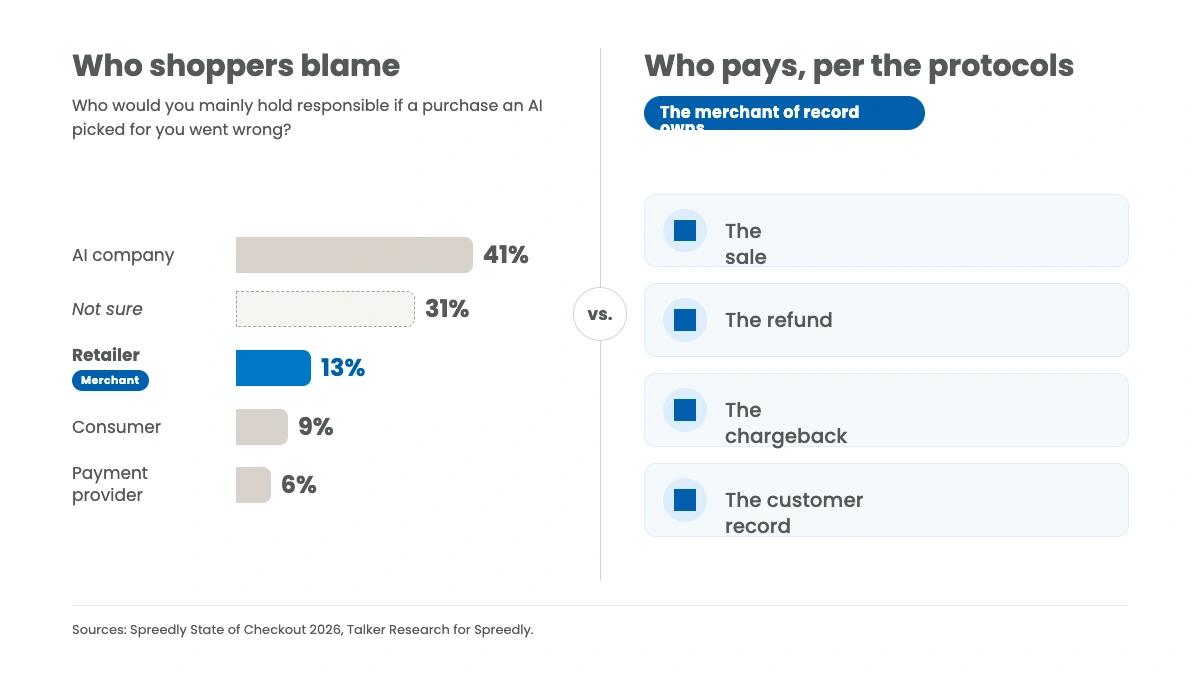
The report names what closes that gap. It says “payment infrastructure that comes with its own dispute resolution, its own insurance, and clearly stated terms adds a second, independent layer of consumer confidence on top of whatever trust the AI layer has already built.” Two things on that list, dispute resolution and clearly stated terms, are merchant of record work.
That divide is also your opening. We asked which company people would trust most to run an AI shopping assistant that spends money for them, and no company got more than 13%. Nobody has earned that trust yet. A merchant that settles agent disputes fast, in a way shoppers can see, can earn it first.
Don’t Let One Processor Own Your Agent Volume
The protocols aren’t the problem. ACP says you can use it “with any compatible PSP,” and UCP keeps financial liability with the business. The risk is in how you connect to agent surfaces, and that often means taking one processor’s bundled agent access.
You can see why the bundle is tempting. One contract, one integration, and you’re live on agent surfaces. The processor’s reason for offering it is just as easy to see. Bundled agent access keeps all that new agent volume on its rails.
The bill comes later. If your agent access runs through one provider, the agent credential, the routing, and the terms of access all live inside that relationship. You’re still the merchant of record on paper. In practice, you can’t move agent volume to a second acquirer or apply your own routing rules, and you go into your next rate negotiation with less leverage.
Our white paper, Future-Proof by Design, digs in further. “When systems are tightly tied to a single gateway or processor, flexibility is constrained and adjustments require structural changes.” It also lays out the alternative. “Payment data is stored outside of any single processor relationship, which allows merchants to route transactions dynamically while maintaining consistent policy enforcement.”
The payments leaders we work with say it more bluntly. They want to stay merchant of record, and they’re wary of handing their customer relationship to an LLM platform.
The fix is a multi-PSP setup where your credentials and routing rules sit with you, above any single processor. That’s what payment orchestration does. It’s one layer that connects to many processors, so no single processor owns your agent volume.
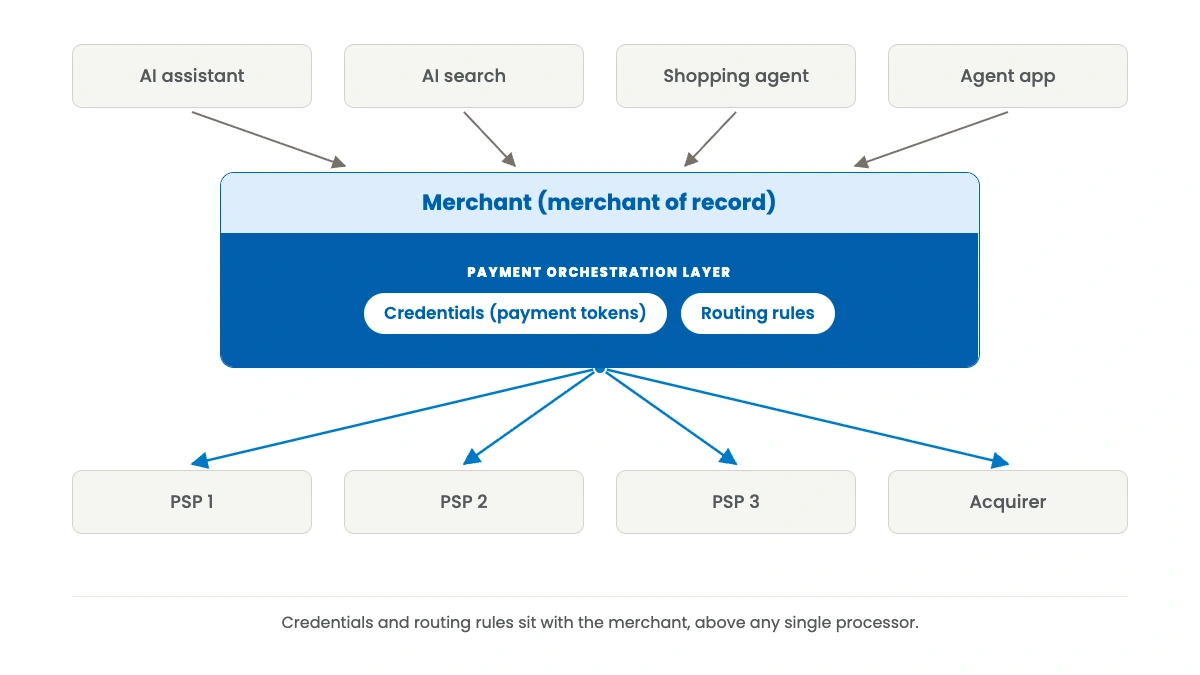
Few companies are set up this way today. The Orchestration Advantage, a June 2026 study by PYMNTS Intelligence and Spreedly of 110 US companies with $10M+ in revenue, found that only 7% had full control of their payment tokens.
If you don’t control the credential, it can’t follow your agent volume to a second processor.
A Checklist for Keeping Merchant of Record Across Agent Surfaces
However you get onto agent surfaces, four things decide whether you’re merchant of record in practice or only on paper.
- Payment credentials stored outside any one processor. Wherever the credential lives, the agent volume follows. Lock the credential to one processor and you’ve locked the volume there too.
- Routing rules you set yourself, including which acquirer gets agent volume. If you don’t set them, the processor carrying your agent traffic sets them for you.
- Fraud and dispute handling that works the same across every PSP. The chargeback is yours on every surface, so the way you handle it should be the same everywhere too.
- One view of every agent-initiated transaction, on every surface. You can’t price dispute risk on volume you can’t see, and you can’t negotiate on volume you can’t count.
We don’t own a card network or an acquiring business, so that means you keep control of your routing, your economics, and your credentials, and you stay merchant of record no matter how many agent surfaces show up. See how it works on our agentic commerce page.

What is a merchant of record?

The business that sells to the customer and accepts the payment. Its name appears on the card statement, and it is responsible for the transaction, including refunds, chargebacks, and card network rule compliance.
Who is the merchant of record when an AI agent makes a purchase?
The merchant selling the goods, not the AI platform. The Agentic Commerce Protocol states businesses "maintain their customer relationships as the merchant of record," and the Universal Commerce Protocol says the business typically retains "financial liability and ownership of the transaction."
What is the difference between a merchant of record and a payment processor?
The merchant of record owns the sale and the customer relationship, and carries refunds and chargebacks. The payment processor moves the transaction between the merchant, the card networks, and the issuing bank on the merchant's behalf.