

.svg)
.svg)
.svg)
.svg)
.svg)

.svg)
.svg)
.svg)








We asked 2,000 US adults a simple question. Which company would you trust most to run an AI shopping assistant that spends money for you? The top answer was “none of the above” at 42%, and Google led the named companies with 13%.
Careful with that 42%, though. It’s the share of people who didn’t pick a company. It doesn’t measure distrust of AI payments.
The survey is our State of Checkout 2026, run by Talker Research. Wondering if all that hesitation means you should wait? The data says move. We’ll walk through what people fear, who they’d blame when a purchase goes wrong, and what that open question costs you.
Trust breaks down when AI starts spending
People already trust AI to help them figure out what to buy. In our survey, 11% of US adults named ChatGPT as their most trusted source for product research, ahead of retailer websites at 9%. Among Gen Z, ChatGPT leads outright at 31%, with Google Search at 12%.
Things change when the AI stops giving advice and starts spending money. We asked people whether they’d let an AI shopping assistant buy something without their approval if it always found the best price. Only 20% said yes outright.
Other research shows the same hesitation. A Harris Poll survey for Visa found that 23% of US consumers trust GenAI to handle payments for them. Visa has a stake in agentic adoption, but the two numbers still line up.
The report puts it well: “It’s a product and UX problem, not a trust-from-zero problem.” That’s good news if you’re planning for agentic commerce. People already want this. They’re waiting for a checkout that shows them what the AI is doing.
Agentic commerce fraud tops the list of fears
Ask people why they won’t let AI buy for them and fraud comes up first. The survey notes that 52% of US adults named fear of fraud as a reason to not trust AI for payments. Lack of trust in AI companies came next at 45%, then fear of overspending at 40%.
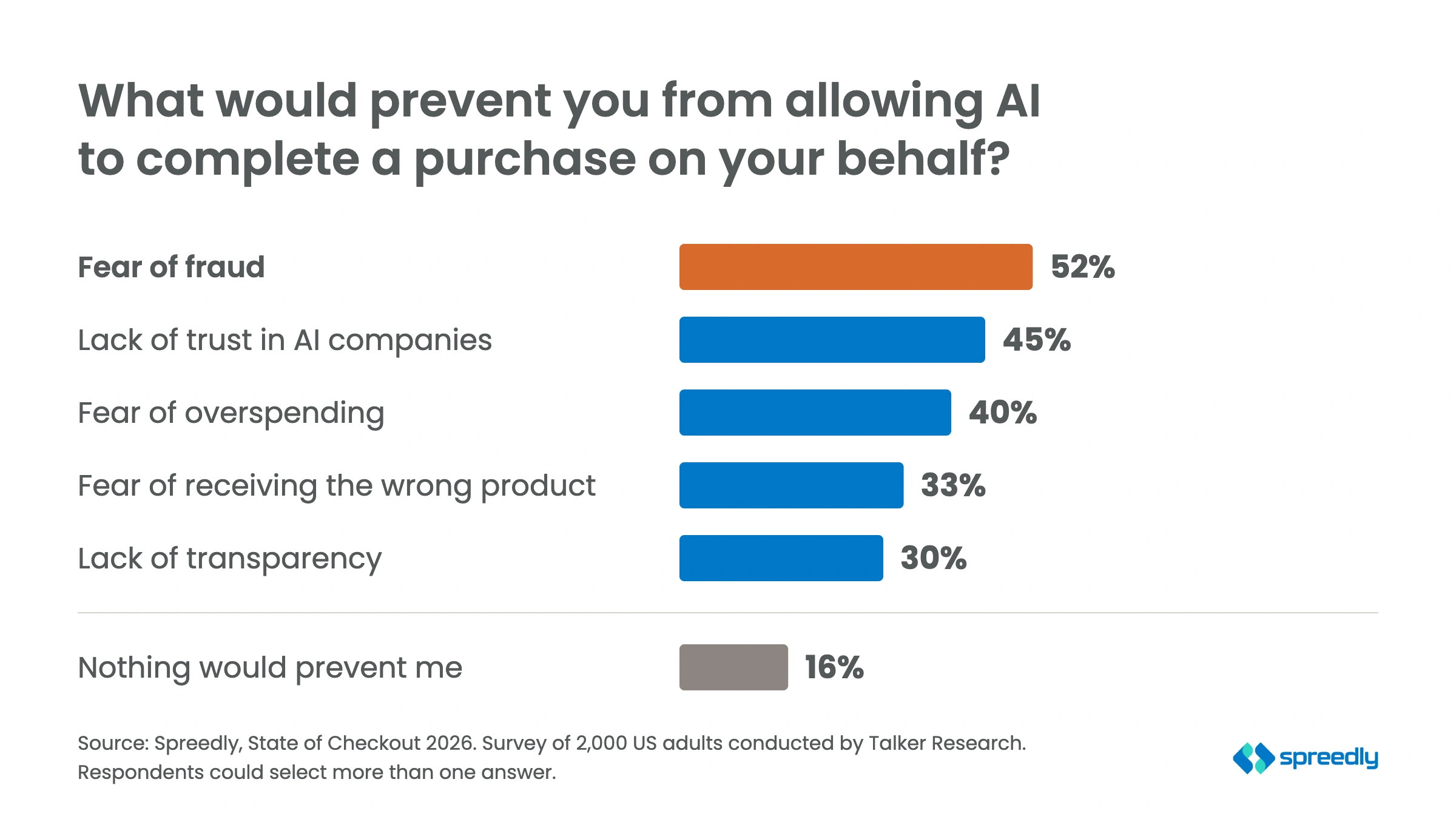
Only 16% said nothing would stop them.
The good news is that payments already has answers for fraud. Teams have run fraud detection, tokenization and dispute resolution on online sales for decades. The trouble is that shoppers can’t see any of it working, and that’s what needs fixing.
Having an AI agent start the purchase doesn’t change that list. Our white paper, Future-Proof by Design, lays out the requirements that still apply when a machine starts the transaction: authentication enforcement, policy boundaries, auditability and regional compliance. The controls people are asking for already exist. Shoppers need to be able to see them.
The report compares this to the early web, when people hesitated to type a card number into any website. Encryption alone didn’t win them over. What did was seeing the safety measures actually work. The report expects the same thing to happen once merchants show real spend caps, visible audit trails and plain-language explanations of what the agent did and why.
Trust in AI companies, at 45%, is a different kind of problem. Fraud has known tools. A reputation problem across the whole AI category is bigger than any one merchant can fix on their own.
AI agent liability is still being negotiated
Right now, nobody owns liability for AI agent purchases. Consumers haven’t settled it, and card networks and issuers are still writing the rules. We asked people who they’d hold responsible if an AI shopping assistant picked a product and something went wrong. The AI company got 41%, 31% weren’t sure and 6% named the payment provider.
The retailer got 13% and the consumer got 9%. This question had a base of 1,703 respondents rather than the full 2,000.
So liability is up for grabs. Almost a third of people have no answer at all, so accountability belongs to whoever makes it visible first. The barrier data says the same thing. Fear of receiving the wrong product came in at 33%, and that’s exactly the situation where nobody knows yet who pays.
The report splits the trust work into two layers. The AI layer needs visible accountability. That means a dispute process, an error-handling policy and an escalation path the shopper can find before anything breaks. The payment layer needs to prove it’s reliable, with protected credentials, clearly stated terms and a record of what was charged and why.
Neither layer covers for the other. It’s the same channel-versus-rails split we drew in The Difference Between Agentic Commerce and Agentic Payments.
The networks and issuers are working on the same question. On April 14, 2026, American Express announced what its press release called an “industry-first” protection for registered agent purchases. It covers charges where a purchase strays from the cardmember’s authenticated intent. Its agentic commerce page still lists the full terms as coming soon.
Mastercard launched Verifiable Intent in March 2026. According to PYMNTS, it creates “a cryptographic audit trail that all parties can consult if a dispute arises.”
When an issuer calls protection for agent error a first and still hasn’t published the terms, the rules aren’t finished. If a vendor tells you liability for agent purchases is settled, ask them how they got ahead of the networks.
When nobody owns liability, somebody still pays for it
The survey also tells you how big the opportunity is. We asked people whether they’d give an AI shopping assistant their payment details for a guaranteed lowest price. Nineteen percent said yes, and another 23% said maybe.
The report says that maybe group “deserves your closest look,” and it’s right. These people haven’t said yes yet, but they’re open to it. They’re open to it before the industry has even finished building the trust tools they’re asking for.
Put the yes and maybe groups together and you’ve got the people a well-explained offer can reach. They’re also the people whose disputes don’t have a clear owner yet.
That’s the catch. When nobody owns the liability, nobody owns the dispute and fraud costs either. While networks and issuers work out the rules, some of that cost lands on the merchant by default.
Measuring it is harder than it sounds. Say you route agent-initiated transactions through several processors. Now that data lives in several places. Without one view of your agent transactions, you can’t separate them from regular online sales, track their dispute rate or price the risk.
To price that risk, you need four facts for each transaction: which agent started it, which credential it used, whether the amount stayed inside the shopper’s limit and how it resolved. With those four facts in one place, you can set a reserve, negotiate terms with an agent platform and show a shopper exactly what happened. Spread across a handful of processor dashboards, they don’t do you much good.
So, wait or move? Move. You’re carrying the cost either way, and you can only measure what you can see.
The First Merchants to Show Their Controls Will Define Trustworthy
The report puts it pretty bluntly: “In a new category, whoever defines ‘trustworthy’ first is going to run away with the ball.” It says the same thing about the company-trust numbers: “The company that builds the most convincing trust infrastructure first is the one that’s going to win this, not the company that already has the biggest logo.”
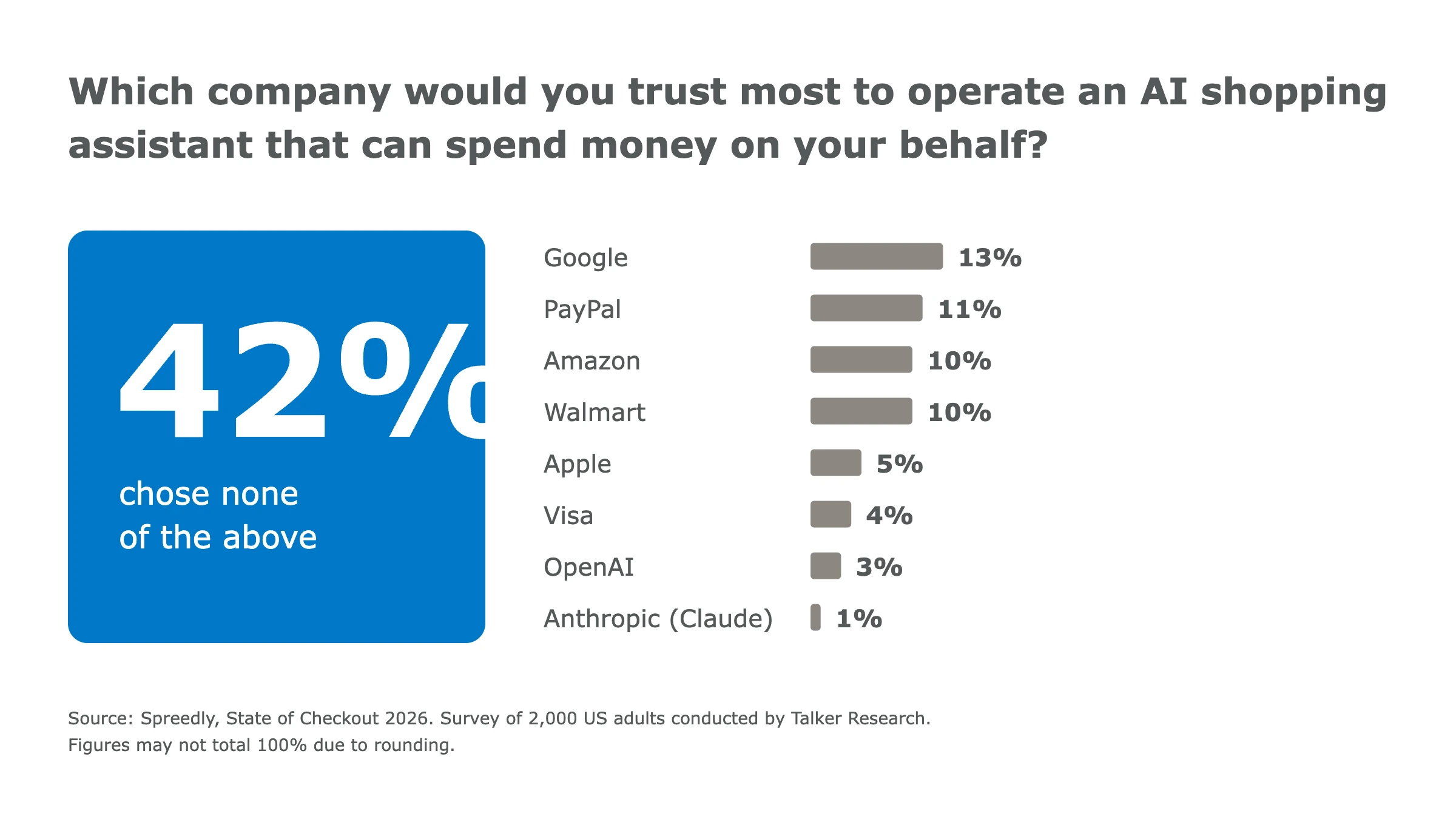
Take another look at that chart. The 42% who didn’t pick anyone outnumber the top-named company more than three to one. No AI platform, wallet or protocol has won people over yet. So the controls you run are the part of trust you actually own.
Know your agent. One control people can see is checking who the agent is before it buys anything. That’s called know your agent, or KYA. VVisa’s Trusted Agent Protocol, announced October 14, 2025, is the network-side version. It helps merchants tell trusted AI agents apart from malicious bots. Our guide to agentic commerce and agentic payments goes deeper on KYA.
Shoppers have already told us what would win them over. They want spend limits they can see, a clear view of what the agent did and someone to hold accountable when it goes wrong. Nobody owns “trustworthy” yet. Whoever shows those controls first gets to define it.
Some of the technology for this already runs at the payment layer. Tokenization swaps the card number for a token, so the agent never touches the shopper’s actual card details. The card networks issue network tokens, and those stay current when a card gets reissued. That keeps the credential tied to the shopper.

Which company do consumers trust most to run an AI shopping assistant?

No company has earned majority trust. In Spreedly's State of Checkout 2026 survey, conducted by Talker Research, 42% of US adults chose none of the above when asked which company they would trust most to operate an AI shopping assistant that spends on their behalf. Google led the named companies at 13%.
What stops consumers from letting AI make purchases?
Fear of fraud leads. In the same survey, 52% named fear of fraud, 45% lack of trust in AI companies, and 40% fear of overspending. Only 16% said nothing would stop them.
Who is responsible when an AI agent buys the wrong thing?
Consumers have not settled it. 41% would hold the AI company responsible, 31% are not sure, and 6% name the payment provider. American Express and Mastercard announced agent-specific protections and dispute tools in 2026, and full rules are still being written.